 qerranews
qerra has officially launched its Self Full Node infrastructure.
This marks a major milestone in the growth of the qerra ecosystem and represents an important step toward building independent, transparent, and decentralized blockchain infrastructure.
Until now, like many blockchain platforms, interactions with the blockchain network partially depended on third-party RPC providers and external infrastructure services. While these services help applications connect to the blockchain quickly, they also introduce dependency on centralized systems outside of the project’s direct control.
With the qerra Self Full Node now live, qerra can directly connect to the blockchain network through its own infrastructure layer.
This improves reliability, strengthens security, enhances transparency, and gives the ecosystem greater operational independence.
Understanding the qerra Self Full Node
A full node is a blockchain server that independently verifies, stores, and synchronizes blockchain data.
Instead of requesting blockchain information entirely from external providers, a self-hosted node communicates directly with the blockchain network and performs critical functions internally.
The qerra Self Full Node now handles:
- Blockchain synchronization
- Transaction verification
- Block validation
- Peer-to-peer communication
- Transaction broadcasting
- Local blockchain data storage
The node continuously connects with other blockchain peers to maintain a fully updated copy of the blockchain ledger in real time.
This allows qerra to independently validate network activity without relying completely on third-party infrastructure providers.
Why Running a Self Full Node Matters?
Many blockchain applications today still rely heavily on centralized RPC providers for blockchain access.
Although convenient, this creates several infrastructure concerns:
- Dependence on external providers
- Service downtime risks
- API rate limitations
- Potential censorship issues
- Reduced infrastructure transparency
- Shared infrastructure vulnerabilities
As blockchain ecosystems grow, infrastructure independence becomes increasingly important.
Launching the qerra Self Full Node helps solve many of these challenges by giving qerra direct blockchain access and independent verification capabilities.
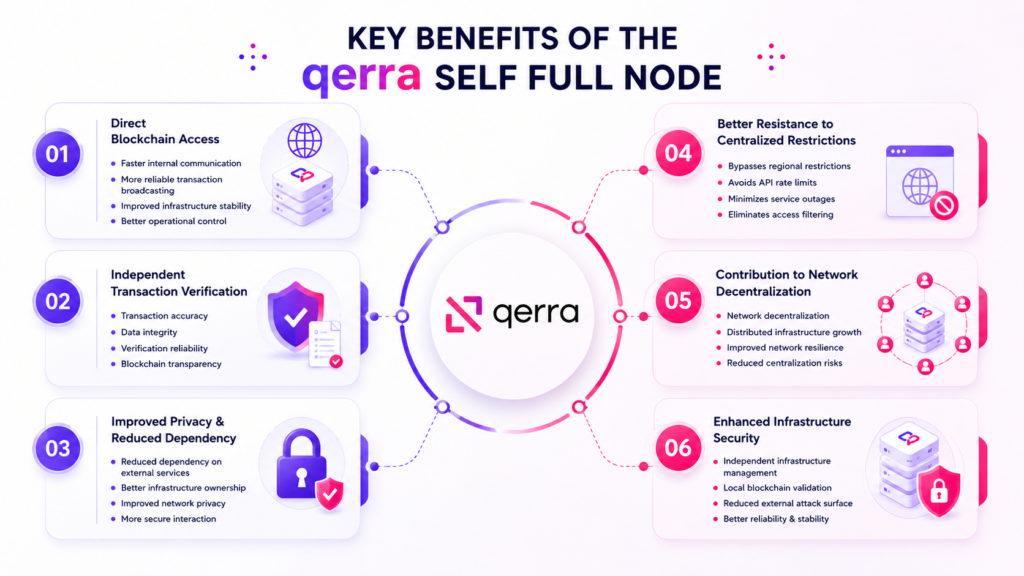
Key Benefits of the qerra Self Full Node
1. Direct Blockchain Access
The qerra Self Full Node communicates directly with the blockchain network without depending entirely on third-party APIs or RPC services.
This allows:
- Faster internal blockchain communication
- More reliable transaction broadcasting
- Improved infrastructure stability
- Better operational control
Direct access creates a stronger and more scalable infrastructure foundation.
2. Independent Transaction Verification
Every transaction processed through the node is independently verified according to blockchain consensus rules.
This improves:
- Transaction accuracy
- Data integrity
- Verification reliability
- Blockchain transparency
Instead of trusting external providers for blockchain responses, qerra can now validate blockchain information internally.
3. Improved Privacy and Reduced Third-Party Dependency
When blockchain requests are routed through external RPC providers, metadata and network requests may pass through third-party infrastructure.
By operating its own node, qerra reduces exposure to external infrastructure and improves ecosystem privacy.
Benefits include:
- Reduced dependency on external services
- Better infrastructure ownership
- Improved network privacy
- More secure blockchain interaction
Infrastructure independence is an important part of Web3 security.
4. Better Resistance to Centralized Restrictions
Public infrastructure providers can sometimes introduce limitations such as:
- Regional restrictions
- API rate limits
- Service outages
- Access filtering
The qerra Self Full Node reduces reliance on these centralized gateways and improves uninterrupted blockchain access for the ecosystem.
This supports the core blockchain principle of permissionless participation.
5. Contribution to Network Decentralization
Every independent full node strengthens the blockchain network.
By operating its own node, qerra actively contributes to:
- Network decentralization
- Distributed infrastructure growth
- Improved network resilience
- Reduced centralization risks
A decentralized network becomes stronger when more independent participants contribute infrastructure resources.
6. Enhanced Infrastructure Security
Shared infrastructure environments can create additional exposure to external risks and service failures.
The qerra Self Full Node helps improve operational security through:
- Independent infrastructure management
- Local blockchain validation
- Reduced external attack surface
- Better infrastructure reliability
- Improved system stability
Strong infrastructure security is essential for sustainable blockchain ecosystems.
How The qerra Self Full Node Works?
The qerra Self Full Node operates by continuously connecting with blockchain peer nodes and synchronizing blockchain data in real time.
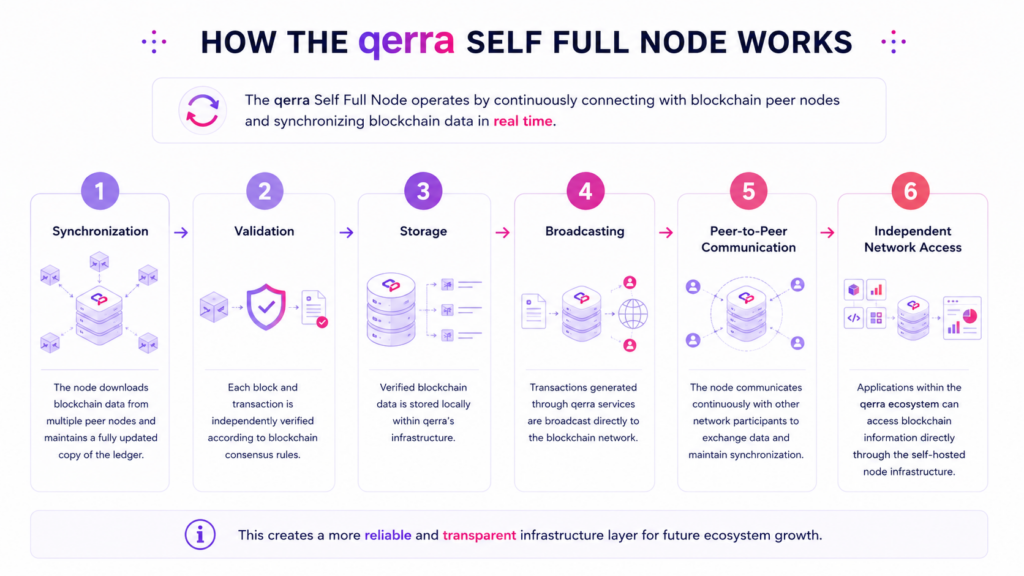
The process works as follows:
1. Synchronization
The node downloads blockchain data from multiple peer nodes and maintains a fully updated copy of the blockchain ledger.
2. Validation
Each block and transaction is independently verified according to blockchain consensus rules.
3. Storage
Verified blockchain data is stored locally within qerra’s infrastructure environment.
4. Broadcasting
Transactions generated through qerra services can now be broadcast directly to the blockchain network.
5. Peer-to-Peer Communication
The node communicates continuously with other network participants to exchange blockchain data and maintain synchronization.
6. Independent Network Access
Applications within the qerra ecosystem can access blockchain information directly through the self-hosted node infrastructure.
This creates a more reliable and transparent infrastructure layer for future ecosystem growth.
Building Long-Term Infrastructure for Web3
Infrastructure is one of the most important yet often overlooked parts of blockchain technology.
Many projects focus only on tokens, applications, or marketing while depending heavily on centralized backend services.
At qerra, we believe long-term ecosystem growth requires long-term infrastructure ownership.
Launching the Self Full Node is part of a broader vision focused on:
- Infrastructure independence
- Ecosystem scalability
- Blockchain transparency
- Decentralization
- Operational security
- Sustainable Web3 growth
This infrastructure foundation will support future development across the qerra ecosystem.
Conclusion
This launch represents a major infrastructure upgrade that strengthens the ecosystem through independent blockchain access, improved transparency, enhanced security, and reduced third-party dependency.
By operating its own node infrastructure, qerra is taking a meaningful step toward building a stronger and more decentralized blockchain ecosystem. The foundation is now live and this is only the beginning for qerra.