 qerranews
Blockchain is built on decentralization, transparency, and user control. But in reality, many platforms still depend heavily on third-party infrastructure providers to access blockchain data and process transactions.
At qerra, we believe true decentralization starts with owning and operating the core infrastructure ourselves.
That is why we are starting the process of running our self full node.
This is an important step for the qerra ecosystem because it improves transaction reliability, strengthens privacy, increases transparency, and reduces dependence on external services.
Simply put — we want to build infrastructure that gives our community more control and a better blockchain experience.
Understanding the Concept of Self Full Node
A full node is a server or computer that stores and verifies the complete blockchain ledger independently.
Instead of relying on third-party RPC providers or external blockchain APIs, a full node communicates directly with the blockchain network. It validates transactions, checks block data, and maintains a synchronized copy of the blockchain.
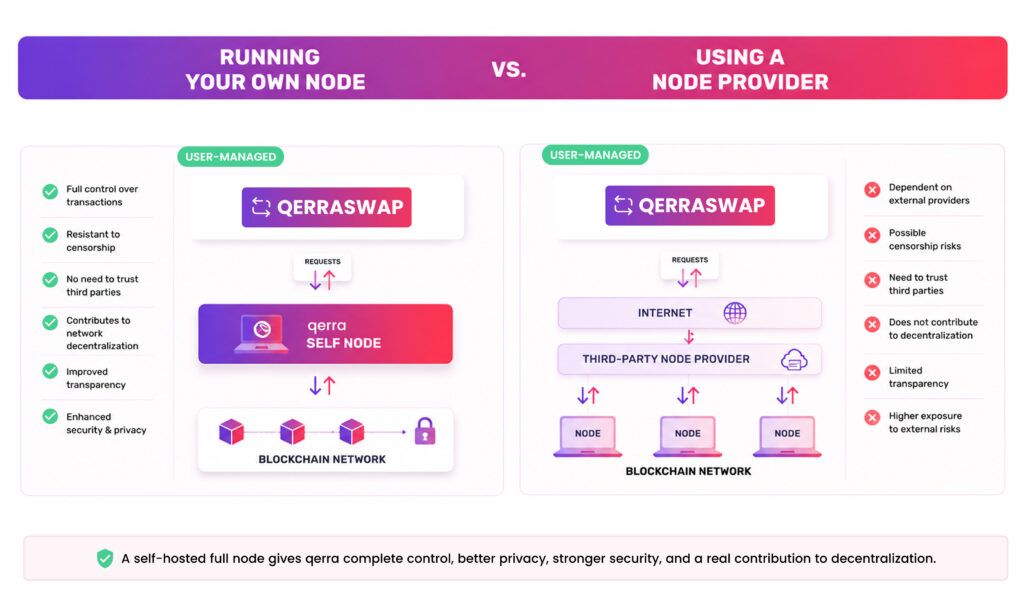
A full node performs several important functions:
- Verifies blockchain transactions independently
- Validates blocks according to network rules
- Stores blockchain history locally
- Broadcasts transactions to the network
- Communicates with other peer nodes
In simple terms, a full node allows a platform to interact directly with the blockchain without depending entirely on external infrastructure providers.
This creates a more secure, decentralized, and reliable environment.
How a Self Node Works?
A self-hosted full node works by connecting directly to the blockchain network and maintaining a complete synchronized copy of the blockchain ledger. The node continuously communicates with other peer nodes, downloads new blocks, verifies transactions according to network rules, and stores blockchain data locally. When a user or application sends a transaction, the node can broadcast it directly to the blockchain without depending entirely on third-party RPC providers or external infrastructure services.
This allows qerra to independently validate on-chain data, improve transaction reliability, strengthen privacy, and maintain direct access to the network. By operating a self node, qerra becomes an active participant in the blockchain ecosystem rather than simply relying on external providers for blockchain connectivity.
How Starting Our Own Node Benefits the qerra Community?
1. Full Control Over Transactions
When transactions are routed through third-party providers, transaction metadata and request information may pass through external infrastructure.
By operating our own node, qerra can broadcast and verify transactions directly through our own infrastructure instead of relying completely on public RPC services.
This provides:
- Better transaction control
- Reduced external dependency
- More reliable transaction handling
- Improved privacy for users
For the community, this means a more independent and secure transaction environment.
2. Transactions Become Resistant to Censorship
Public infrastructure providers can sometimes impose restrictions, rate limits, or regional access limitations.
If too many blockchain applications depend on the same centralized infrastructure providers, it creates a potential censorship risk.
Running our own node helps qerra reduce that dependency.
Our infrastructure can interact directly with the blockchain network, allowing transactions to be propagated without relying entirely on third-party gateways.
This supports the core blockchain principle of permissionless access.
3. No Need to Fully Trust Third Parties
One of the original goals of blockchain technology was to remove unnecessary trust from digital systems.
However, many applications still depend on external providers to deliver blockchain data and transaction services.
With a self-hosted full node, qerra can independently verify blockchain information instead of simply trusting third-party responses.
This improves:
- Data integrity
- Infrastructure reliability
- Network independence
- Verification accuracy
Independent verification is one of the strongest advantages of blockchain infrastructure.
4. Contribution to Network Decentralization
Every full node strengthens the blockchain network.
A decentralized blockchain becomes more secure and resilient when more independent nodes participate in transaction validation and network synchronization.
By operating our own node, qerra actively contributes to:
- Network decentralization
- Distributed infrastructure growth
- Better network resilience
- Reduced centralization risks
This benefits not only qerra but also the broader blockchain ecosystem.
5. Improved Transparency
A full node provides direct access to blockchain data directly from the source.
Instead of relying on cached or filtered third-party APIs, qerra can independently monitor and validate network activity in real time.
This improves operational transparency by allowing:
- Direct blockchain verification
- Accurate transaction monitoring
- Independent block validation
- Reliable on-chain data access
Transparency is stronger when the infrastructure itself is independently controlled.
6. Enhanced Security and Privacy
External infrastructure providers can become single points of failure.
If a third-party RPC service experiences downtime, attacks, or service disruptions, connected applications and users may also be affected.
Running our own node helps qerra improve infrastructure security by reducing reliance on shared external systems.
Benefits include:
- Improved infrastructure stability
- Better network reliability
- Reduced exposure to external risks
- Enhanced operational security
- Greater privacy protection
Strong infrastructure is an important part of blockchain security.
Conclusion: Running a Node Is a Step Toward True Decentralization
Building and operating a full node is more than a technical upgrade.
It is a commitment to decentralization, transparency, and infrastructure independence.
At qerra, we believe blockchain projects should not only talk about decentralization — they should actively build toward it.
By starting our own full node infrastructure, we are taking an important step toward creating a stronger, more secure, and more reliable ecosystem for our community.
This is only the beginning, and we are excited about what comes next for qerra.