 qerranews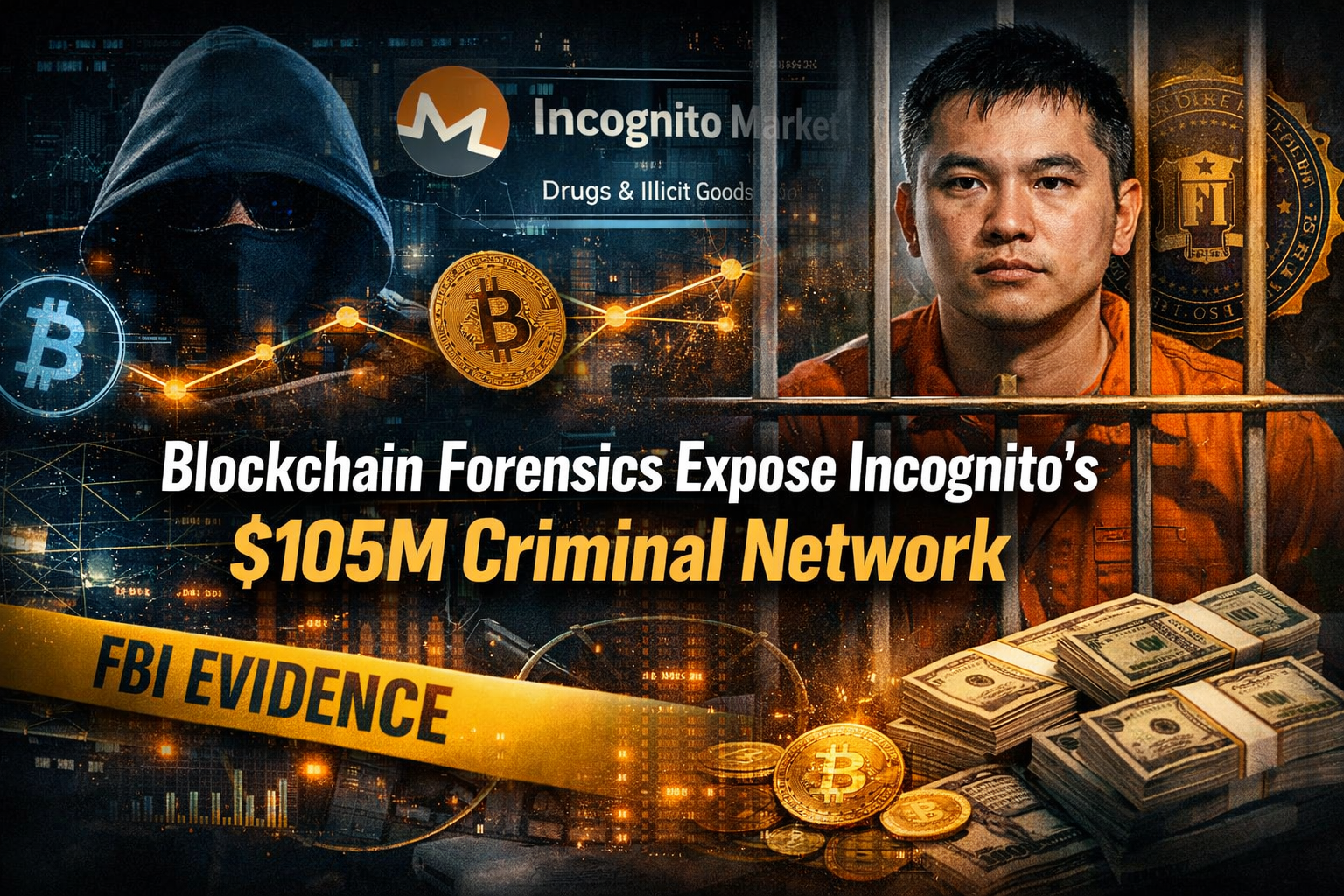
Blockchain forensics has once again proven that cryptocurrency is far from anonymous when investigators know where to look. The creator of Incognito Market, a major dark web drug marketplace, has been sentenced to 30 years in prison after US authorities used blockchain transaction tracing to link him directly to the platform’s illicit operations.
Incognito Market processed more than $105 million in illegal drug sales between 2020 and 2024, relying heavily on cryptocurrency payments. Despite the platform’s use of privacy-focused tools and coins, blockchain transparency ultimately played a decisive role in exposing its operator.
Rise Of Incognito Market
Incognito Market launched in October 2020 and quickly grew into a major online black market for narcotics and misbranded medications. The platform allowed buyers and sellers to transact using Bitcoin (BTC) and Monero (XMR), taking a 5% commission on every sale.
Incognito Market owner sentenced to 30 years. “Lin orchestrated more than $105 million in online sales of illegal drugs, harming hundreds of thousands,” said U.S. Attorney Jay Clayton.https://t.co/rR1rTZCViA
— US Attorney SDNY (@SDNYnews) February 3, 2026
The marketplace marketed itself as a secure and anonymous hub for illegal drug trading, attracting thousands of users globally. By the time it shut down in March 2024, Incognito had facilitated over $105 million in illicit transactions, according to the US Justice Department.
Creator Sentenced To Prison
On Wednesday, a Manhattan federal court sentenced Rui-Siang Lin, the creator and operator of Incognito Market, to 30 years in prison. Lin pleaded guilty in December 2024 to multiple charges, including narcotics trafficking conspiracy, money laundering, and conspiring to sell misbranded medication.
In addition to the prison sentence, Lin was ordered to serve five years of supervised release and to forfeit more than $105 million, representing proceeds generated by the dark web platform.
US Attorney Jay Clayton emphasized the broader message behind the sentencing, stating that decentralization and blockchain technology do not provide immunity from law enforcement scrutiny.
Blockchain Tracing Breakthrough
Despite Incognito’s reliance on privacy coins like Monero, investigators were able to follow critical transaction trails. According to the FBI, blockchain forensics linked Incognito’s crypto wallets to accounts held in Lin’s real name at centralized crypto exchanges.
Agents identified a wallet controlled by Lin that received funds from a known Incognito wallet. Those funds were then transferred through a crypto swapping service, converting Bitcoin into Monero before being deposited into an exchange account registered to Lin.
This onchain activity created a clear financial link between the marketplace and its creator, undermining Incognito’s claims of anonymity.
Exchange Records Reveal Identity
The breakthrough came when the crypto exchange provided the FBI with know-your-customer (KYC) records tied to the account receiving Incognito-linked funds. These records included a photo of Lin’s Taiwanese driver’s license, along with an email address and phone number.
Investigators then connected the same contact details to a Namecheap domain registrar account. That account was used to purchase a domain promoting Incognito Market, further tying Lin’s real-world identity to the dark web platform.
Authorities also noted that the volume of Lin’s exchange deposits closely mirrored Incognito’s growth.
Following The Money Trail
According to court documents, Lin’s exchange deposits rose from approximately $63,000 in 2021 to nearly $4.2 million in 2023. A second exchange account linked to Lin received $4.5 million between July and November 2023 alone.
In March 2024, shortly before Incognito shut down, Lin allegedly stole at least $1 million from users by draining platform accounts. He then attempted to blackmail buyers and vendors, threatening to release transaction histories and wallet addresses unless payments were made.
Arrest At JFK Airport
In May 2024, US authorities arrested Lin, a Taiwanese national, at John F. Kennedy International Airport in New York. The arrest followed months of blockchain analysis and data collection tying him to Incognito’s operations.
The case highlights how blockchain forensics, combined with exchange compliance and digital identity records, can pierce even sophisticated attempts at online anonymity.
Blockchain Transparency Prevails
The Incognito case underscores a growing reality in crypto crime enforcement: while cryptocurrencies enable pseudonymous transactions, they also create permanent, traceable records. Law enforcement agencies are increasingly leveraging onchain data, exchange cooperation, and forensic tools to dismantle large-scale criminal networks.
For regulators and investigators, the message is clear — the blockchain remembers everything.