 qerranews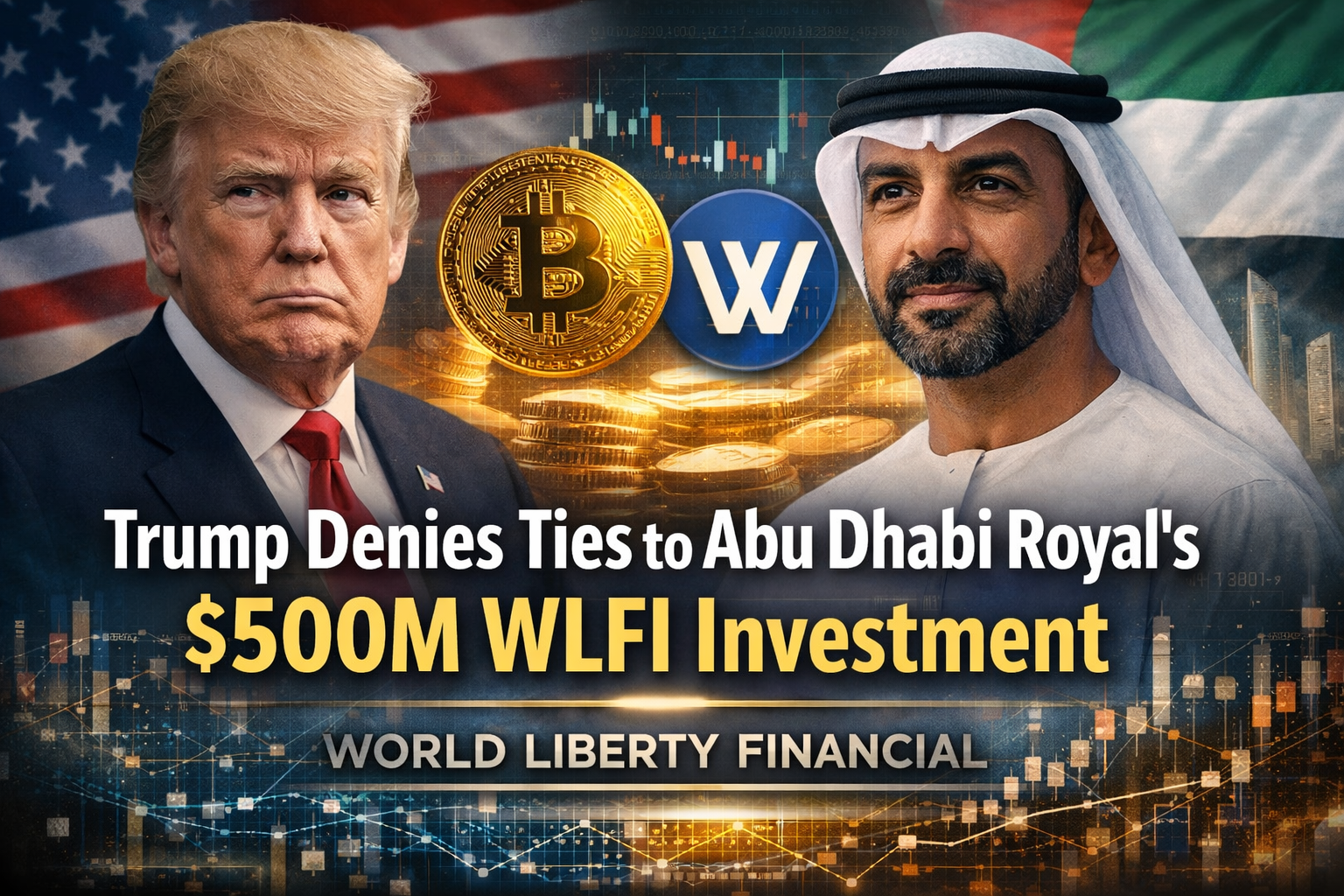
US President Donald Trump has denied any knowledge of a reported $500 million investment by an Abu Dhabi royal into World Liberty Financial (WLFI), a crypto platform closely associated with his family. The reported deal, which allegedly occurred just days before Trump’s inauguration, has raised questions around transparency, foreign influence, and the intersection of politics and cryptocurrency.
Trump Denies Deal Knowledge
Speaking to reporters on Monday, Trump dismissed claims that he was personally involved in or aware of the reported WLFI investment.
“I don’t know about it,” Trump said when asked about the alleged deal. “My sons are handling that — my family is handling it. I guess they get investments from different people.”
JUST IN: 🇺🇸🇦🇪 President Trump says he did not know Abu Dhabi invested $500 million in his World Liberty crypto project.
— Bitcoin Black (@Bitcoinblacck) February 2, 2026
"I don't know about it. My sons are handling that, I guess they get investments from people." pic.twitter.com/AOBosetnpE
Trump’s comments attempt to distance himself from the reported transaction, which has quickly drawn scrutiny due to its timing and scale. World Liberty Financial is one of several crypto ventures tied to Trump and his immediate family, positioning the president at the center of ongoing debates around political influence in digital asset markets.
$500M Stake Reported
According to a Wall Street Journal report published Saturday, Sheikh Tahnoon bin Zayed Al Nahyan — a senior member of the Abu Dhabi royal family — acquired a 49% stake in World Liberty Financial for $500 million.
The investment was reportedly finalized four days before Trump’s inauguration, a detail that has intensified media attention and regulatory interest. The report cited internal WLFI documents and individuals familiar with the matter.
If accurate, the transaction would make Sheikh Tahnoon’s investment vehicle the largest shareholder in WLFI, granting significant influence over the crypto platform’s future direction.
Funds Routed Through Entities
The Wall Street Journal reported that the first installment of the investment came from Aryam Investment 1, a company backed by Sheikh Tahnoon. That initial payment totaled $250 million.
Of that amount, approximately $187 million was reportedly directed to Trump-family-controlled entities. An additional $31 million was sent to an entity tied to two of WLFI’s founders, Zak Folkman and Chase Herro.
These payment details have fueled debate over governance, ownership transparency, and whether political connections played a role in the structuring of the deal.
WLFI Ownership Structure
World Liberty Financial was founded by nine individuals, including Donald Trump and his sons Donald Trump Jr., Eric Trump, and Barron Trump. The platform has positioned itself as a major crypto initiative aligned with pro-business and pro-innovation narratives.
If Aryam Investment’s reported stake is confirmed, it would make the Abu Dhabi-linked firm WLFI’s largest shareholder. Critics argue that such a structure could expose a US-based crypto company to foreign influence, especially one linked to a sitting president.
Supporters, however, argue that private crypto companies routinely accept international investment and that WLFI should not be held to a different standard.
Abu Dhabi Royal Profile
Sheikh Tahnoon bin Zayed Al Nahyan is a powerful figure in the United Arab Emirates with longstanding diplomatic and economic ties to the United States. He serves as chairman of Group 42, an Abu Dhabi-based artificial intelligence conglomerate.
In December, Group 42 received approval from the US Department of Commerce to purchase advanced semiconductor chips from Nvidia and Advanced Micro Devices, highlighting Sheikh Tahnoon’s close working relationship with US regulators and technology firms.
His reported investment in WLFI would mark a significant expansion into the cryptocurrency sector.
Political Scrutiny Grows
The reported WLFI investment could intensify political and regulatory scrutiny of Trump’s involvement in crypto ventures.
In January, Democratic Senator Elizabeth Warren urged the Office of the Comptroller of the Currency (OCC) to pause consideration of World Liberty Financial’s application for a US bank charter until Trump divested his interest in the platform.
Warren cited concerns about conflicts of interest and the influence of political power in financial regulation.
Regulators Push Back
The OCC ultimately rejected Warren’s request, stating that World Liberty Financial’s application would undergo the same rigorous review as any other submission.
The regulator emphasized that political or personal financial ties would not influence its decision-making process, pushing back against claims of preferential treatment.
WLFI spokesperson David Wachsman echoed that position in comments to Bloomberg.
“The idea that, when raising capital, a privately held American company should be held to some unique standard that no other similar company would be held is both ridiculous and un-American,” Wachsman said.
Crypto And Politics Collide
The controversy highlights the growing overlap between cryptocurrency, global capital flows, and political power. As crypto platforms attract increasingly large international investments, questions around transparency, governance, and national influence are becoming harder to ignore.
While Trump has denied direct involvement in the reported WLFI deal, the situation underscores the challenges facing regulators as crypto moves closer to the political mainstream.
Whether the reported investment results in further investigations or regulatory action remains to be seen, but the episode adds another chapter to the evolving relationship between crypto and global politics.