 qerranews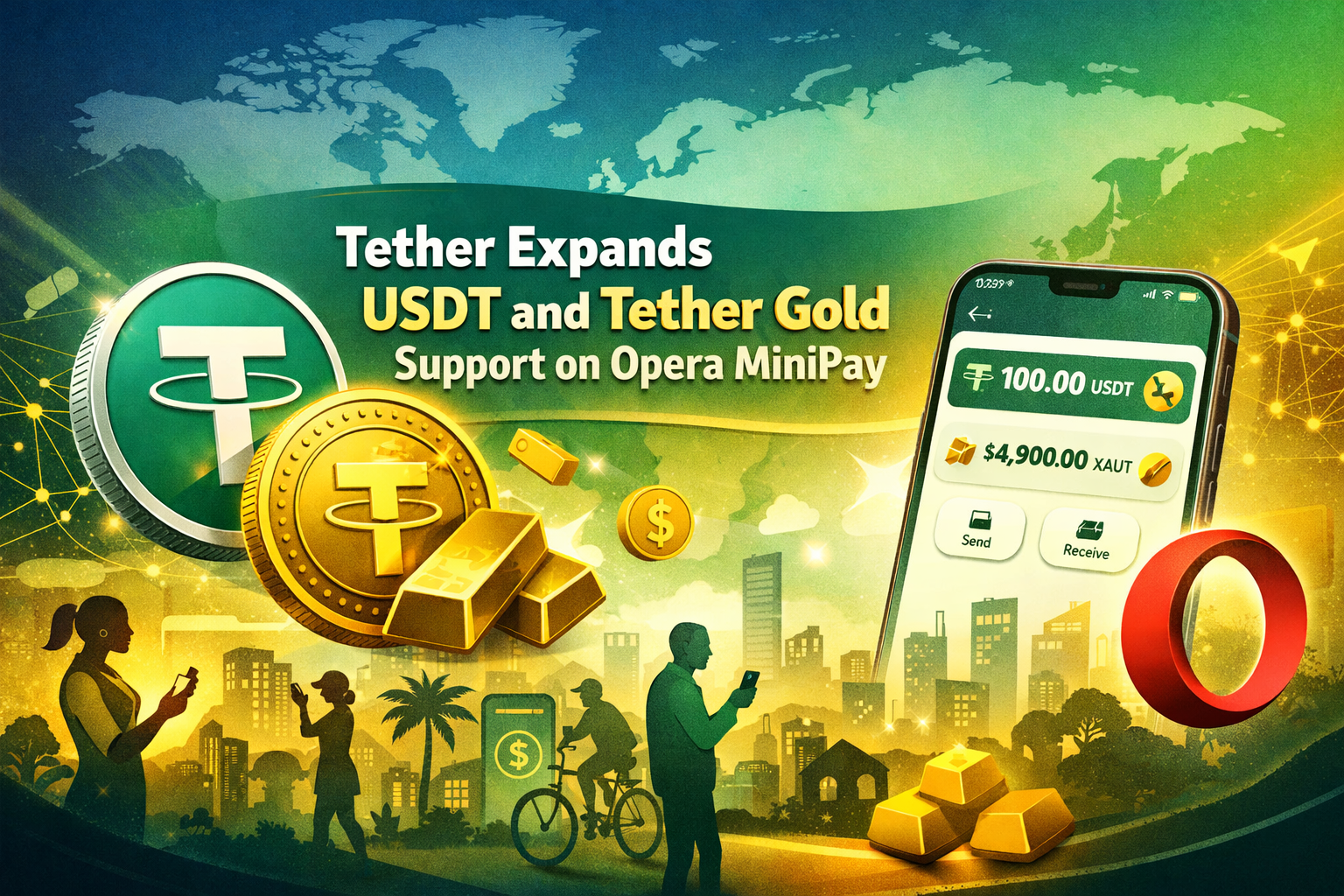
Tether strengthens stablecoin access via Opera MiniPay
Stablecoin issuer Tether has expanded support for its flagship products USDT and Tether Gold (XAUT) within Opera’s MiniPay wallet, a move aimed at improving financial access across emerging markets.
The partnership between Tether and web browser provider Opera seeks to address long-standing challenges around access to stable value, cross-border payments, and inflation-resistant savings in regions such as Africa, Latin America, and Southeast Asia.
Tether announced on Monday that MiniPay users can now seamlessly use USD-denominated stablecoins and tokenized gold within Opera’s self-custodial wallet, which is built on the Celo blockchain.
Expanding financial inclusion in mobile-first regions
According to Tether, the integration is designed to help millions of people in underbanked economies gain access to reliable digital financial tools using only a smartphone.
“Tether’s mission has always been to provide simple, reliable access to stable value for people who need it most,” said Tether CEO Paolo Ardoino, highlighting the company’s long-term focus on financial inclusion.
MiniPay’s design removes many traditional barriers to entry. The wallet requires only a mobile phone number to activate and does not rely on complex onboarding procedures that often limit adoption in developing economies.
The app is currently operational in 60 countries, with 12.6 million activated wallets and more than 350 million transactions processed to date. Opera said MiniPay recorded 50% user growth in Q4, driven largely by demand in emerging markets.
Growing demand for stablecoins and tokenized gold
Stablecoins like USDT play a critical role in regions experiencing high inflation, volatile local currencies, or limited access to traditional banking services. By integrating USDT into MiniPay, users can save, transfer, and transact in dollar-denominated assets without relying on local financial infrastructure.
Across all integrations, more than $153 million was sent or received through MiniPay in December, underscoring the growing appetite for stable, low-cost digital payments in mobile-first economies.
In addition to USDT, MiniPay now supports Tether Gold (XAUT), a tokenized asset backed by physical gold. Tether positions XAUT as an option for inflation-resistant savings, particularly appealing in countries where purchasing or storing physical gold is difficult.
XAUT surged to an all-time high of $5,600 in late January, tracking gains in spot gold markets amid global economic uncertainty. According to CoinGecko, Tether Gold has a circulating supply of 712,747 XAUT and a market capitalization of approximately $3.4 billion.
Opera MiniPay and the Celo ecosystem
MiniPay is built on the Celo blockchain, a network designed specifically for mobile-friendly payments and low transaction fees. The infrastructure enables near-instant transfers with minimal costs, making it well suited for everyday payments and remittances.
Opera has increasingly positioned MiniPay as a gateway for real-world crypto adoption, especially in regions where traditional banking penetration remains low but smartphone usage is widespread.
By integrating both stablecoins and tokenized real-world assets, Opera and Tether are expanding the wallet’s utility beyond simple peer-to-peer transfers, enabling users to store value and hedge against inflation directly within a browser-based ecosystem.
Stablecoin market faces broader headwinds
Despite rising adoption in emerging markets, the broader stablecoin market has recently shown signs of contraction amid a wider crypto market downturn.
Following rapid expansion over the past two years, total stablecoin market capitalization began declining in December, ending a sustained growth trend, according to data from CryptoQuant.
Analyst Darkfost noted that net stablecoin inflows to exchanges have largely reversed.
“After an initial sharp decline of $9.6 billion, followed by a brief period of stabilization, stablecoin flows have once again turned negative, with more than $4 billion in outflows,” the analyst said.
The shift suggests rising risk aversion among market participants, with many users choosing to move stablecoins off exchanges or exit crypto markets altogether.
Meanwhile, the broader cryptocurrency market has declined roughly 38% from its peak total market capitalization of $4.4 trillion in October, adding pressure to digital asset valuations across the board.
Long-term outlook for stablecoins in emerging markets
While market volatility continues to impact crypto prices, demand for practical, utility-driven applications such as stablecoin payments and savings remains resilient in developing economies.
Tether’s expansion into Opera MiniPay reflects a broader industry trend toward real-world use cases, particularly in regions where crypto adoption is driven less by speculation and more by necessity.
As stablecoins and tokenized assets become increasingly integrated into mobile wallets, partnerships like Tether and Opera’s could play a key role in shaping the next phase of global financial inclusion.