 qerranews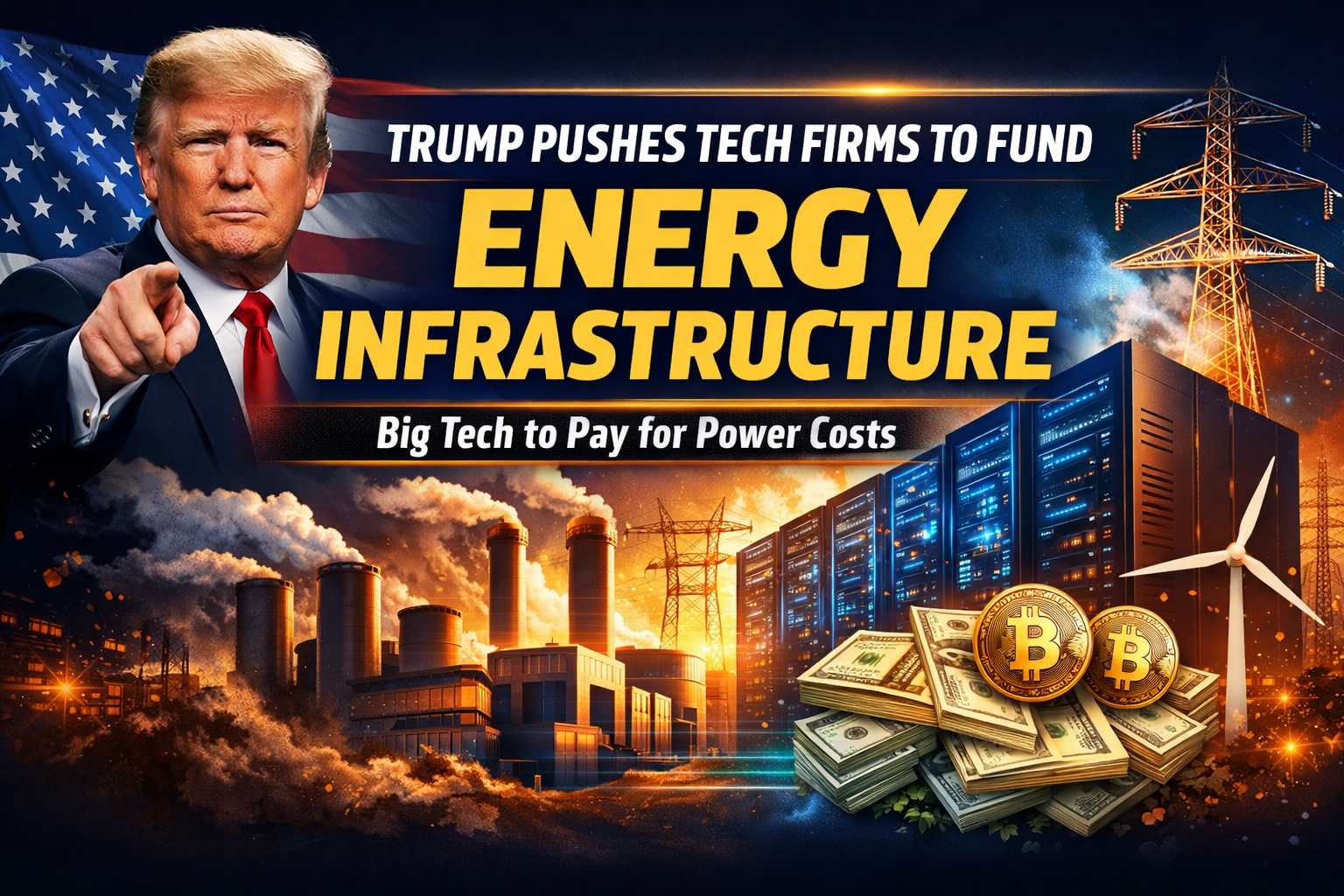
Big Tech Power Costs Under Scrutiny
US President Donald Trump has pledged to make major technology companies pay for the electricity infrastructure needed to support their rapidly expanding data centers, as national power consumption surges to record levels. The proposal comes amid rising concerns that ordinary Americans are being forced to absorb higher electricity bills driven by energy-intensive tech operations, particularly those linked to artificial intelligence.
“I never want Americans to pay higher electricity bills because of data centers,” Trump said in a post on his social media platform Truth Social. The president argued that the financial burden of powering massive server facilities should fall squarely on the companies that build and operate them, rather than households already struggling with higher living costs.
Trump Targets Rising Power Bills
Trump blamed Democratic energy policies for sharp increases in household electricity costs and vowed to secure commitments from leading US technology firms to protect consumers. He said discussions are already underway with major players, with a formal announcement expected in the coming weeks.
According to data from the St. Louis Federal Reserve, the average price of electricity per kilowatt-hour in US cities has risen by roughly 40% over the past five years. While inflation and fuel prices have played a role, Trump and his allies argue that soaring demand from data centers is becoming a major contributor to grid stress and long-term costs.
Microsoft Signals Early Compliance
Trump singled out Microsoft as the first company to agree to meaningful changes. The president said Microsoft will begin implementing measures this week aimed at ensuring Americans do not “pick up the tab” for the company’s power consumption through higher utility bills.
While specific details have not yet been disclosed, analysts expect changes could include direct investment in grid upgrades, dedicated power generation projects, or long-term renewable energy contracts tied specifically to data center expansion. Microsoft has already been one of the largest corporate buyers of renewable energy globally, but Trump’s remarks suggest a broader financial responsibility model may be emerging.
Data Center Demand Keeps Climbing
US data center electricity usage has surged alongside the rapid growth of cloud computing and artificial intelligence. In 2025, data centers accounted for approximately 5.2% of total US electricity consumption, or about 224 terawatt hours (TWh), according to Visual Capitalist. That figure represented a 21% increase from the previous year.
Projections suggest the trend is far from slowing. McKinsey & Company estimates that by 2030, US data center power demand could exceed 600 TWh, representing nearly 11.7% of total national electricity consumption. Such growth would place unprecedented strain on power grids, especially in regions hosting clusters of hyperscale facilities.
Why Data Centers Use So Much
Data centers are among the most energy-intensive industrial facilities in the modern economy. Cooling systems alone account for roughly 30% to 40% of total energy usage, as servers generate enormous amounts of heat. Servers and IT equipment consume an additional 40% to 60%, according to Network Installers.
The rise of AI workloads has further intensified demand. The International Energy Agency estimates that electricity consumption from AI-focused data centers is growing at an annual rate of around 30%, far outpacing the 9% growth rate associated with conventional server operations. This rapid expansion has raised alarms among regulators, utilities, and policymakers.
AI Boom Meets Political Reality
Trump acknowledged that data centers are essential to America’s technological leadership, particularly in artificial intelligence.
“We are the ‘hottest’ country in the world, and number one in AI,” he said, emphasizing that data centers are critical to national security and economic growth.
However, he stressed that innovation should not come at the expense of everyday Americans. His proposal reflects a broader political shift toward making large corporations shoulder more infrastructure costs, particularly when their operations create indirect financial pressure on consumers.
Bitcoin Mining Enters Debate
Bitcoin mining has also drawn scrutiny due to its reliance on large-scale data centers and high electricity consumption. Critics often argue that mining operations drive up local power prices, but recent analysis challenges that assumption.
ESG analyst Daniel Batten compared changes in utility bills nationwide between 2021 and 2024 with those in Texas, a state known for its high concentration of Bitcoin mining. He found that bill increases in Texas closely matched national trends, suggesting mining was not a primary driver of higher costs.
“Neither in the data nor in peer-reviewed studies is there evidence to support the claim that Bitcoin mining increases power bills for consumers,” Batten concluded.
Environmental Trade-Offs and Benefits
Beyond cost concerns, Bitcoin mining has demonstrated several environmental benefits when integrated responsibly. These include absorbing excess renewable energy, funding green energy research, stabilizing power grids, and reducing methane emissions through flare-gas capture. Supporters argue that such benefits contrast sharply with conventional data center expansion that relies heavily on existing grid capacity.
What Comes Next for Big Tech
If Trump follows through, US technology companies could face a fundamental shift in how they plan data center expansion. Directly funding power generation, grid upgrades, or localized energy infrastructure may become a prerequisite for growth.
For now, the debate highlights a growing tension between America’s digital ambitions and its aging power infrastructure—one that is likely to intensify as AI, cloud computing, and crypto continue to scale.