 qerranews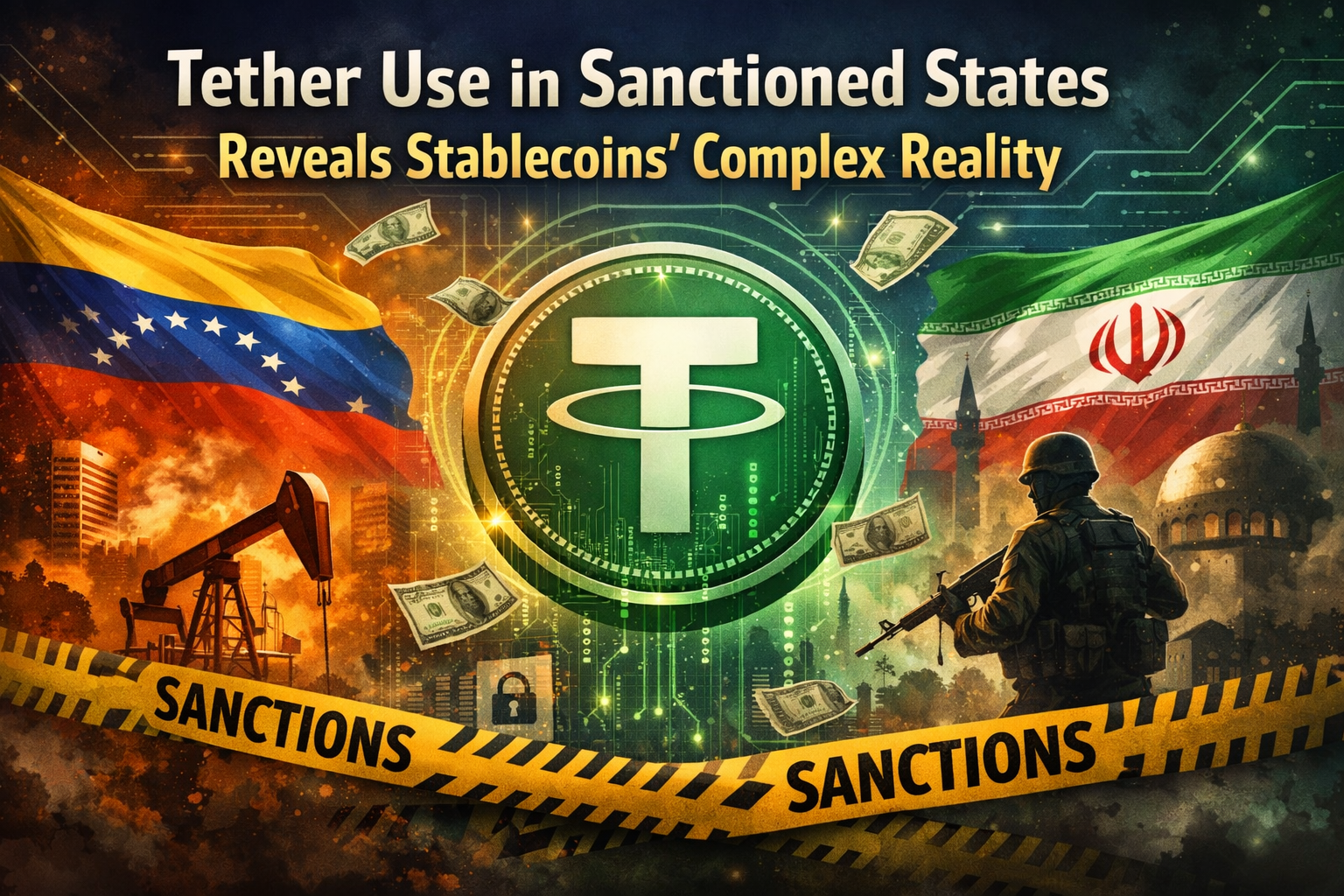
Stablecoins’ Double-Edged Nature
The growing adoption of stablecoins in sanctioned economies like Venezuela and Iran has reignited debate over the true nature of crypto’s most widely used financial tools. Assets such as Tether’s USDT operate at the intersection of financial freedom and regulatory concern—serving as a lifeline for everyday citizens while simultaneously being leveraged by sanctioned entities to move capital across borders.
As inflation surges, local currencies collapse, and access to traditional banking erodes, stablecoins have emerged as an alternative financial rail. Yet their borderless design also makes them attractive for governments and organizations seeking to bypass international sanctions, placing issuers like Tether under increasing scrutiny.
Iran’s Economic Pressure Cooker
Iran has faced renewed unrest in early 2026 as the national currency, the Iranian rial, plunged to record lows against the U.S. dollar. Worsening economic conditions triggered widespread protests across the country, leading to mass arrests, reports of fatalities, and temporary domestic internet shutdowns imposed by authorities.
For ordinary Iranians, crypto adoption has become less about speculation and more about survival. With decades of currency devaluation eroding purchasing power, many citizens have turned to stablecoins as a hedge against inflation and systemic risk.
Tron-based USDT has reportedly become the most commonly used crypto asset in Iran due to its low transaction fees and speed. Stablecoins allow users to store value, transfer funds, and engage in commerce without relying on a fragile banking system.
Restrictions And Crackdowns
Despite grassroots adoption, Iran’s crypto ecosystem has faced mounting obstacles. In 2025, a major hack on the country’s largest exchange dented confidence, while widespread Tether wallet blacklisting disrupted usage.
The Iranian government also imposed strict limits on stablecoin ownership in late September, capping individual holdings at $10,000 and annual purchases at $5,000 per person. These measures were aimed at curbing capital flight but further underscored crypto’s growing importance within the country’s informal economy.
Sanctions Evasion Allegations
While citizens use stablecoins defensively, blockchain analytics firm TRM Labs alleges that sanctioned Iranian entities have exploited the same tools on a much larger scale. According to a report released Friday, Iran’s Islamic Revolutionary Guard Corps (IRGC) allegedly moved over $1 billion in stablecoins since 2023 through two UK-based front companies—Zedcex and Zedxion.
TRM Labs claims the firms functioned as a unified financial infrastructure supporting sanctions evasion efforts. The network reportedly facilitated cross-border transfers, currency conversions, and jurisdiction hopping on behalf of one of the world’s most heavily sanctioned military organizations.
The report also identified Babak Zanjani—a financier previously sanctioned for laundering billions in oil revenue—as a key figure in the alleged operation.
Venezuela’s Stablecoin Economy
Venezuela offers another stark example of stablecoin duality. Years of hyperinflation and economic mismanagement have rendered the Venezuelan bolivar largely unusable, pushing citizens toward alternatives like USDT.
In many parts of the country, stablecoins have become a de facto medium of exchange. Venezuelans reportedly use USDT to pay for everyday services, from haircuts to landscaping, often bypassing banks entirely.
“It’s how you pay your landscaper and how you pay for your haircut,” Venezuelan crypto entrepreneur Mauricio Di Bartolomeo told The Wall Street Journal. “You can use tether basically for anything.”
Even without regulated exchanges, stablecoin adoption continues to expand as trust in traditional financial institutions remains low.
State-Level Stablecoin Usage
Beyond retail adoption, Venezuela’s state-run oil company, Petroleos de Venezuela (PDVSA), has also reportedly embraced USDT. Facing U.S. sanctions imposed in 2020, the firm allegedly began demanding oil payments directly in stablecoins to avoid restrictions on international banking.
Estimates suggest PDVSA accepts up to 80% of its oil revenue via Tether, using the asset to settle both incoming and outgoing payments. This state-level usage has intensified regulatory pressure on stablecoin issuers and highlighted the challenges of enforcing sanctions in a decentralized financial environment.
Tether’s Blacklisting Strategy
In response, Tether has increasingly cooperated with U.S. authorities to combat sanctions evasion. The company uses wallet blacklisting to freeze funds linked to illicit activity, limiting the ability of bad actors to access or move assets.
According to AMLBot data, Tether blacklisted approximately $3.3 billion worth of funds between 2023 and late 2025. Of that total, $1.75 billion consisted of Tron-based USDT.
Over the past weekend, Tether reportedly froze an additional $182 million across five Tron wallets, though it remains unclear whether the action was linked to Venezuela or Iran.
Stablecoins At A Crossroads
The experiences of Venezuela and Iran illustrate the fundamental contradiction of stablecoins. They empower individuals in failing economies while simultaneously testing the limits of global financial enforcement.
As regulators push for stricter oversight and issuers enhance compliance tools, stablecoins remain caught between accessibility and control. Their future will likely depend on whether the industry can preserve financial inclusion without enabling large-scale sanctions evasion.
For now, Tether’s expanding footprint in sanctioned states underscores a reality policymakers can no longer ignore: stablecoins are no longer a niche innovation—they are part of the global financial system.