 qerranews
Ripple Aims for Banking License
Ripple Labs has officially joined the wave of crypto companies seeking legitimacy in the eyes of U.S. regulators. In a move that reflects growing alignment between the crypto sector and traditional finance, Ripple is applying for a national banking license from the U.S. Office of the Comptroller of the Currency (OCC). This comes just days after Circle Internet Financial made a similar move — filing to form a national trust bank that would oversee reserves for its USDC stablecoin.
Ripple CEO Brad Garlinghouse confirmed the news in a post on X (formerly Twitter), stating that the firm has formally submitted its application and is committed to full regulatory compliance.
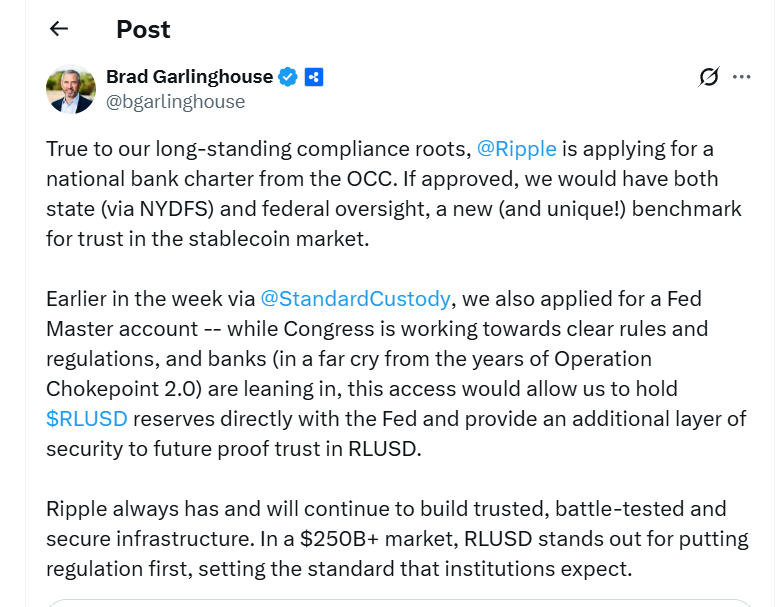
“True to our long-standing compliance roots, Ripple is applying for a national bank charter from the OCC,” Garlinghouse wrote.
The application is a bold step that, if approved, would put Ripple under the dual oversight of federal and state regulators. Ripple’s U.S. dollar-backed stablecoin, RLUSD, is already regulated by the New York Department of Financial Services (NYDFS), but gaining a national charter would mark a major evolution in Ripple’s operational model.
The timing of the move is notable — it coincides with the U.S. Senate’s advancement of the GENIUS Act, a bipartisan bill that lays the groundwork for stablecoin regulation. The bill includes mandates that larger stablecoin issuers be supervised by the OCC, giving regulatory clarity to firms like Ripple and Circle that are betting on the long-term success of fiat-pegged digital assets.
Stablecoin Market Heats Up
Ripple’s stablecoin, Ripple USD (RLUSD), is now being positioned as a trustworthy player in a rapidly evolving stablecoin ecosystem. The company believes that becoming a nationally chartered bank would boost confidence in RLUSD and allow for greater interoperability with traditional financial institutions.
Garlinghouse emphasized that approval would represent a “new (and unique!) benchmark for trust in the stablecoin market.” With regulatory bodies like the NYDFS already involved, the addition of OCC oversight could potentially set RLUSD apart from other non-bank-issued stablecoins in terms of compliance and transparency.
Ripple’s timing also strategically mirrors that of Circle, the issuer of USDC — the world’s second-largest stablecoin. Circle’s own banking license application is aimed at forming a national trust bank, and it reflects similar motivations: proactive compliance with the GENIUS Act, transparent reserve management, and regulatory certainty.
Both firms appear to be responding directly to Washington’s shifting stance on stablecoins. The GENIUS Act would require stablecoin issuers to maintain full reserve backing, undergo regular audits, and allow for oversight from both the OCC and state regulators. In short, stablecoins are moving out of the regulatory gray area — and Ripple is moving quickly to adapt.
Ripple Applies for Fed Access
In an even more ambitious step, Ripple has also applied for a Master Account with the U.S. Federal Reserve. If granted, this access would allow Ripple to directly interact with the U.S. central banking system — including holding RLUSD reserves directly with the Fed.
According to Garlinghouse,
“This access would allow us to hold RLUSD reserves directly with the Fed and provide an additional layer of security to future-proof trust in RLUSD.”
This would mark a significant shift in the operational design of stablecoins, moving them closer to central bank-backed money infrastructure. It’s a model more akin to how commercial banks operate — and a substantial evolution from the early, decentralized ethos of crypto.
Ripple’s application to the Federal Reserve was submitted through Standard Custody, a crypto custody firm the company acquired in early 2024. This move suggests Ripple is building out a vertically integrated financial services ecosystem, from issuance and custody to reserves management — all under formal regulatory oversight.
XRP Surges on Charter News
Ripple’s bold regulatory moves have not gone unnoticed in the market. The price of XRP, the native token of the XRP Ledger, climbed over 3.2% following the bank charter news, hitting a 24-hour high of $2.27 before slightly pulling back to $2.24, according to CoinGecko.
The XRP rally came just hours after Garlinghouse’s announcement, signaling investor optimism about Ripple’s expanding influence in both crypto and traditional financial sectors.
While XRP is not directly tied to RLUSD or to the bank charter application, the token’s performance often mirrors sentiment around Ripple Labs’ broader strategic moves. Gaining OCC approval would lend significant credibility to the firm, which has spent years in legal battles with the SEC over its token’s classification.
A New Phase for Crypto Banks
The entry of crypto-native firms like Ripple and Circle into the banking space signals the start of a new era — one in which crypto meets compliance and blockchain firms integrate directly with traditional monetary systems.
Only a handful of crypto companies — such as Anchorage Digital — have successfully secured a national bank charter in the U.S. If Ripple’s application is approved, it would become one of the few blockchain firms with direct access to the Federal Reserve system.
This represents a dramatic pivot from the days of “Operation Chokepoint 2.0”, when crypto firms claimed that regulators were actively cutting them off from the banking system. Garlinghouse noted that attitudes in Washington have shifted dramatically: “Congress is working towards clear rules and regulations, and banks (in a far cry from the years of Operation Chokepoint 2.0) are leaning in.”
The convergence of crypto and banking is no longer just theoretical — it’s unfolding in real time. With the GENIUS Act moving forward in Congress and leading crypto firms embracing regulation, the U.S. may soon see a regulated stablecoin market that operates under the same rules as traditional financial institutions.
Conclusion
Ripple’s application for a U.S. banking license and access to the Federal Reserve marks one of the most significant developments in the stablecoin sector to date. As the U.S. government moves to formally regulate dollar-backed digital currencies, Ripple is taking proactive steps to lead the charge.
With the potential for full regulatory approval and a direct relationship with the U.S. central banking system, Ripple is positioning itself as a trustworthy, compliant, and future-ready player in the digital asset space. The outcome of its banking charter application could set a powerful precedent for the entire crypto industry — and usher in a new phase of crypto’s integration with global finance.