 qerranews
Dorsey Unveils Bitchat Beta
Jack Dorsey, the co-founder and former CEO of Twitter, has officially launched the beta version of BitChat, a decentralized, peer-to-peer messaging application that doesn’t rely on internet access. The project, described by Dorsey as a weekend experiment, has now evolved into a fully functioning prototype aimed at empowering users with offline communication and privacy-first protocols.
The announcement came via Dorsey’s post on X (formerly Twitter) on July 7, signaling his continued push toward decentralized technologies and open-source infrastructure. The timing also aligns with a growing interest in censorship-resistant communication tools globally.
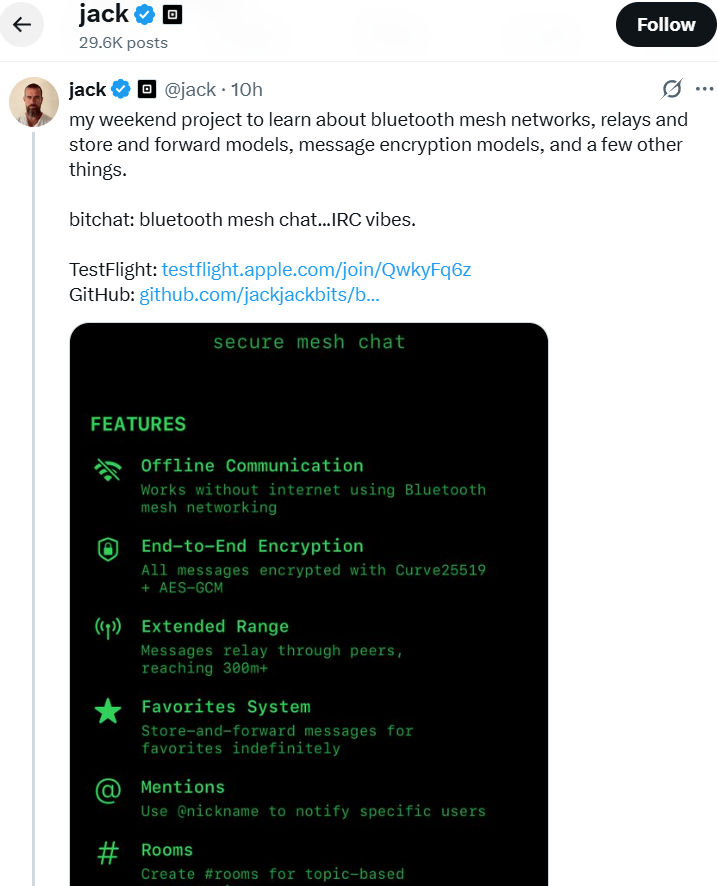
Unlike traditional messaging apps that rely on centralized servers or cloud infrastructure, BitChat uses Bluetooth Low Energy (BLE) mesh networking. This setup enables users in close proximity to connect directly with one another, with each device acting as both a sender and a message relay. The mesh network forms dynamically and self-organizes, eliminating the need for internet access, cell towers, or traditional Wi-Fi infrastructure.
Whether in remote locations, under oppressive regimes, or during natural disasters, BitChat offers a resilient means of communication—even when traditional networks fail.
How BitChat Works Offline
BitChat’s technical foundation relies heavily on BLE mesh networking. It allows short-range communications between nearby devices, passing messages device-to-device in a “store and forward” manner. Each participating phone becomes part of a decentralized communication chain, extending the network organically.
In real-world terms, this means that as long as someone in the chain is within Bluetooth range, your message can eventually be passed down the line—even if the recipient is several hops away. This concept isn’t entirely new (similar ideas power apps like Bridgefy and Briar), but Dorsey’s implementation takes things further with modern cryptographic standards and a developer-first approach.
BitChat also integrates store-and-forward mechanics, which allow messages to be temporarily stored on intermediary devices if the intended recipient is offline. Once that person comes back into range or reconnects to the mesh, the message is forwarded. This functionality ensures better reliability in unstable or disconnected environments.
Messages sent via BitChat are transient—they are stored only in memory and are designed to self-delete after delivery or a predefined duration. This limits long-term data retention and aligns with the platform’s privacy-centric philosophy.
Encryption, Privacy, and Security
At the heart of BitChat’s functionality is its strong emphasis on encryption and digital safety. It uses the following key technologies:
- X25519: A public-key cryptographic algorithm used to securely exchange encryption keys between devices in a peer-to-peer manner. It ensures that messages are readable only by the intended recipient.
- AES-256-GCM: Once the key exchange is completed, the message content is encrypted using AES-256-GCM—a widely respected standard in the cryptographic community for its speed and resistance to tampering.
- Argon2id: For group messaging or “rooms,” BitChat introduces password protection using Argon2id, a memory-hard key derivation algorithm that helps defend against brute-force attacks. This provides a secure environment for private group conversations without relying on central authorities.
This layered security approach ensures that all communication remains private, encrypted, and secure—even when transmitted over a decentralized and untrusted mesh network.
Importantly, BitChat is also open-source. Its codebase is available on GitHub, allowing independent developers, researchers, and privacy advocates to inspect, audit, and contribute to the project. Dorsey has consistently advocated for open systems, and BitChat reinforces that stance.
A Step Toward Censorship Resistance
Perhaps the most powerful implication of BitChat’s launch is its potential for real-world activism and anti-censorship use cases. In countries where governments suppress dissent or restrict online access, tools like BitChat offer a decentralized alternative that is hard to monitor, block, or take down.
Unlike centralized platforms that can be pressured or surveilled, BitChat has no servers to target. Its mesh-based infrastructure is resilient and self-sufficient, allowing protestors, journalists, or marginalized groups to communicate securely—even in the absence of internet connectivity.
This design aligns closely with the cypherpunk movement—a philosophy that champions the use of cryptography, privacy tools, and decentralized tech to defend civil liberties in the digital age. Dorsey has long supported this vision, from funding Bitcoin development to backing open protocols like Nostr.
His departure from the board of Bluesky in 2024 signaled a shift in focus. BitChat appears to be a direct continuation of that ideological journey, prioritizing user sovereignty, encryption, and independence from Big Tech intermediaries.
Looking Ahead: Future of BitChat
Despite the buzz surrounding its beta release, BitChat is still labeled as experimental. Dorsey was clear in his announcement that the platform is a work-in-progress and likely to evolve with community input. At this stage, BitChat is available via Apple TestFlight and only for iOS users, though open-source contributions may accelerate Android development and broader cross-platform adoption.
There are challenges ahead. BLE mesh networking has limitations, including short-range connectivity, limited bandwidth, and higher latency compared to traditional messaging systems. However, for specific use cases like emergency communication, political activism, or travel in disconnected areas, BitChat offers something uniquely valuable.
In a world where messaging apps are routinely scrutinized for data collection, backdoor surveillance, and server outages, BitChat’s model stands in stark contrast—no servers, no surveillance, no central control.
Dorsey’s entry into decentralized messaging marks a notable moment in tech history. With BitChat, he’s not just promoting a new app—he’s making a statement: Digital communication should be private, resilient, and owned by the people who use it.
Final Thoughts
BitChat’s beta launch is not just another app release. It’s the realization of a philosophy—decentralization, encryption, and peer-to-peer communication without gatekeepers. While still early and imperfect, the project shows immense potential.
As more users grow disillusioned with centralized platforms that compromise on privacy or succumb to censorship, the demand for tools like BitChat will only increase. Dorsey’s involvement brings not just credibility but a chance to galvanize developers and users around a shared vision for secure, decentralized messaging.
Whether BitChat becomes a global standard or remains a niche tool, it signals a clear direction for the future: messaging without borders, without surveillance, and without compromise.