 qerranews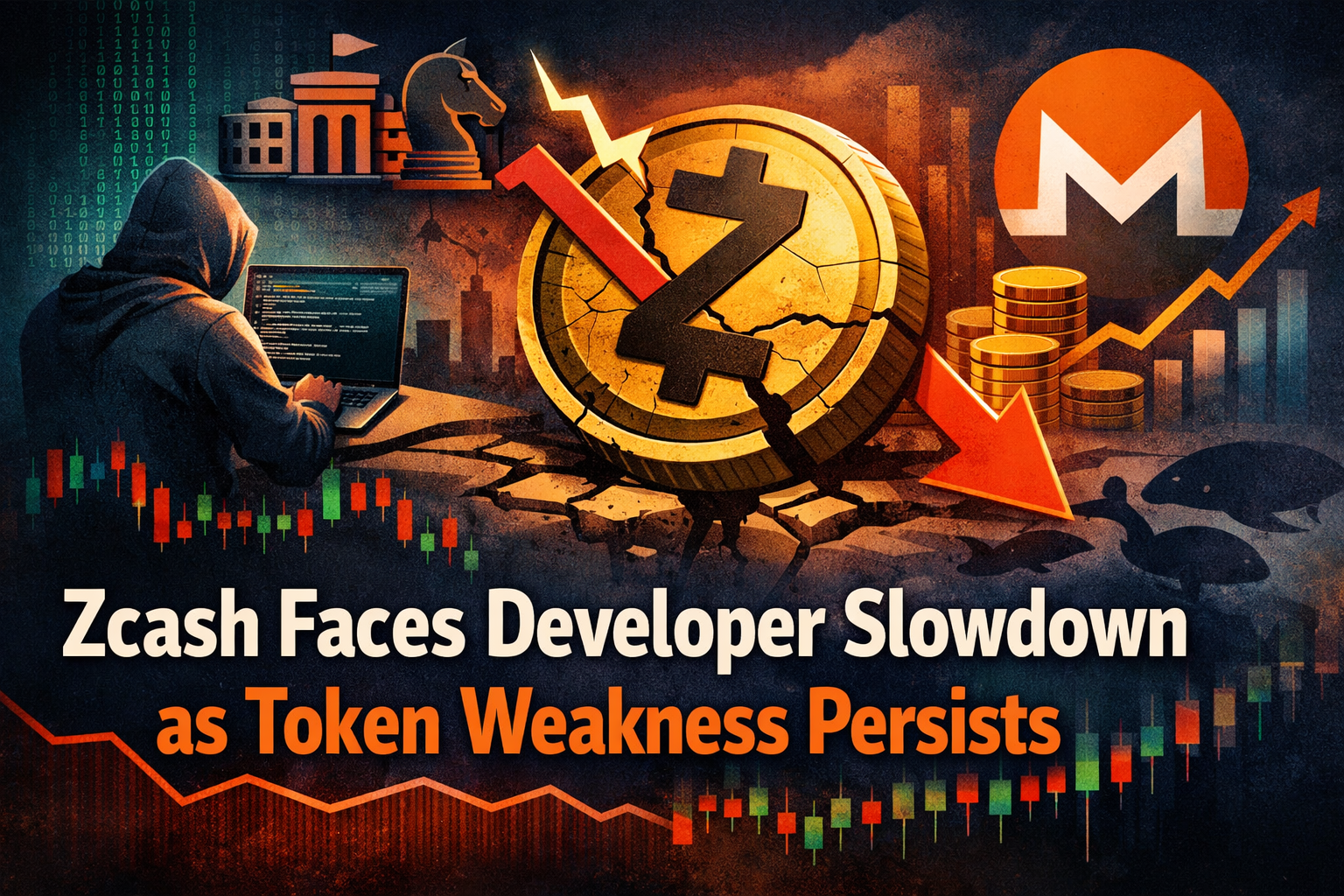
Zcash developer activity has dropped to its lowest level in years, coinciding with a prolonged decline in the ZEC token price and growing uncertainty around governance disputes within the ecosystem. As development momentum slows, market sentiment around the privacy-focused cryptocurrency continues to weaken, raising fresh concerns about Zcash’s competitive positioning in the privacy coin sector.
Zcash Developer Activity Hits Lows
Developer activity linked to Zcash has fallen to its weakest level since November 2021, according to data from market intelligence firm Santiment. The data, shared in a Thursday post on X, highlights a significant reduction in code contributions and development engagement tied to the Zcash protocol.
Historically, developer activity has been viewed as a leading indicator of long-term project health in the cryptocurrency market. Santiment noted that projects showing sustained innovation often outperform peers, while those that slow development efforts tend to lag behind.
“Rising development activity often leads to standout altcoins emerging above the pack,” Santiment said, adding that the opposite holds true when projects “let off the gas” on innovation. For Zcash, the decline in developer momentum has come at a particularly sensitive time.
ZEC Price Extends Two-Month Decline
Alongside weakening development metrics, the ZEC token has continued its downward trajectory. Over the past two months, ZEC has fallen roughly 40%, reflecting broader uncertainty surrounding the project’s future direction.
The token also dropped 14% over the past week alone, trading near $433 at the time of writing. This sustained price weakness has placed ZEC among the underperforming privacy-focused cryptocurrencies in recent market cycles, even as parts of the broader crypto market stabilize.
The combination of declining price action and falling developer engagement has reinforced bearish sentiment, particularly among retail investors closely tracking onchain and GitHub metrics.
Governance Dispute Weighs Sentiment
A key factor behind the slowdown appears to be an ongoing governance dispute involving the Electric Coin Company (ECC), the primary development team behind Zcash, and Bootstrap, the nonprofit organization supporting the protocol.
ECC recently announced plans to separate from Bootstrap and form a new company, citing what it described as “malicious governance actions.” The move followed internal disagreements related to control, funding, and long-term strategy for Zcash-related infrastructure.
Bootstrap, in its official response, stated that board members had discussed “external investment and alternative structures to privatize” Zashi, the self-custodial wallet designed for private Zcash transactions. The dispute has since become public, adding another layer of uncertainty to the ecosystem.
ECC Developers Launch cashZ Wallet
Despite the governance tensions, ECC developers have continued working on new tools. On Thursday, the team announced they are developing a new Zcash-compatible wallet called cashZ, which is expected to launch within the next few weeks.
The wallet aims to support private ZEC transactions and aligns with ECC’s broader push to maintain development independence following its separation from Bootstrap. However, it remains unclear whether the launch of cashZ will be enough to reverse declining developer participation across the wider Zcash ecosystem.
Zcash Foundation Addresses Concerns
In response to growing investor concerns, the Zcash Foundation emphasized that the protocol’s open-source structure ensures resilience regardless of organizational changes. According to the foundation, no single entity has unilateral control over the Zcash blockchain.
“This structure ensures that changes within a single organization, or across many of them, do not compromise the integrity or continuity of the Zcash blockchain,” the foundation wrote in a statement published Thursday.
While the reassurance highlights Zcash’s decentralized design, market participants appear unconvinced in the short term, as reflected in continued selling pressure on the ZEC token.
Whale Activity Signals Mixed Confidence
Interestingly, not all market participants are bearish. Onchain data from crypto intelligence platform Nansen shows that large holders, or whales, accumulated approximately $1.17 million worth of ZEC over the past week. Meanwhile, newly created wallets added an additional $2.14 million in spot ZEC.
This accumulation suggests that some investors view the governance turmoil and price decline as a buying opportunity. However, whale activity alone has not been enough to offset broader market skepticism.
Monero Reclaims Privacy Coin Lead
Adding to Zcash’s challenges, privacy-focused rival Monero (XMR) surpassed ZEC in market capitalization on Thursday, reclaiming its position as the largest privacy-preserving cryptocurrency. According to CoinMarketCap data, Monero’s resurgence reflects stronger relative demand amid ongoing regulatory and governance clarity.
The shift underscores intensifying competition within the privacy coin sector, where sustained development, community cohesion, and clear governance frameworks play a critical role in long-term success.
Outlook for Zcash Ecosystem
Zcash now faces a critical period as it navigates governance restructuring, declining developer activity, and persistent token weakness. While its open-source design provides technical resilience, rebuilding developer momentum and restoring investor confidence may prove challenging in the near term.
Whether initiatives like cashZ and potential organizational restructuring can reinvigorate the ecosystem remains to be seen. For now, Zcash’s performance will likely depend on its ability to resolve internal disputes and reestablish itself as a leading innovator in privacy-focused blockchain technology.