 qerranews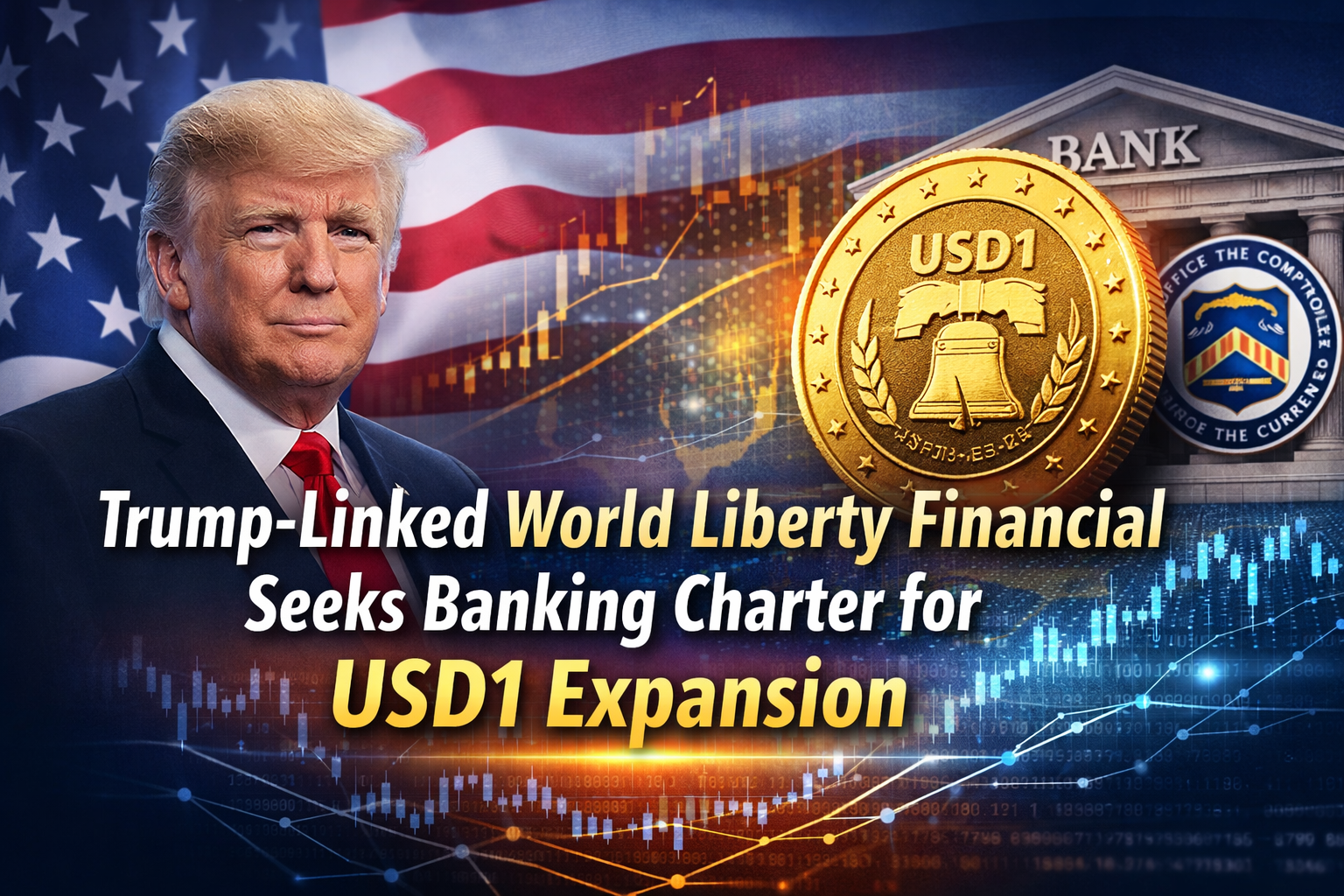
The Trump family–backed crypto platform World Liberty Financial has taken a major step toward institutional legitimacy by applying for a US national trust banking charter. The move is aimed at expanding the reach of its USD1 stablecoin and bringing key operations such as issuance, custody, and conversion fully in-house.
The application highlights how stablecoins are increasingly moving from the fringes of crypto into the core of regulated financial infrastructure, even as political scrutiny around crypto intensifies.
Banking Charter Filing Explained
World Liberty Financial confirmed that its subsidiary, WLTC Holdings, has filed an application with the Office of the Comptroller of the Currency (OCC) for a national trust bank charter. If approved, the charter would allow the company to operate as a regulated trust bank without offering traditional retail banking services such as deposits or loans.
Instead, the trust bank would focus on digital asset services, including issuing, custodying, and redeeming stablecoins. For World Liberty, this structure is designed specifically to support USD1, its US dollar–pegged stablecoin, while complying with federal banking standards.
By seeking a national charter, World Liberty is signaling its intention to operate within the same regulatory framework as other crypto-native financial institutions already approved by US regulators.
Expanding Control Over USD1
A core motivation behind the banking charter application is greater operational control over USD1. Currently, World Liberty relies on third-party providers such as BitGo to handle custody and settlement functions.
Under a national trust charter, the company would be able to issue, custody, and convert USD1 directly. This would enable fee-free minting and redemption of the stablecoin, along with seamless conversion between US dollars and USD1 for institutional users.
According to World Liberty CEO Zach Witkoff, institutions are already using USD1 for cross-border payments, settlement, and treasury management. Consolidating these functions under one regulated entity would allow World Liberty to offer a full-stack stablecoin solution tailored to institutional demand.
Institutional Stablecoin Adoption
Stablecoins are becoming a critical tool for institutional finance, offering faster settlement, lower transaction costs, and programmable money features. World Liberty’s push for a banking charter reflects a broader industry trend toward regulated digital cash infrastructure.
With institutional investors increasingly cautious about counterparty risk, a federally regulated trust bank could make USD1 more attractive for use in enterprise payments, onchain settlement, and treasury operations.
The ability to custody not only USD1 but also other stablecoins under a regulated framework further positions World Liberty as a potential digital asset service provider for traditional financial institutions exploring blockchain-based solutions.
OCC Signals Crypto Openness
World Liberty’s application comes as the OCC shows growing openness toward crypto-focused financial institutions. In December, the regulator issued five conditional approvals for national trust bank charters to firms including Circle, Ripple, Fidelity Digital Assets, BitGo, and Paxos.
Comptroller of the Currency Jonathan Gould said at the time that new entrants into the federal banking system promote innovation, competition, and consumer access to financial services. The approvals marked a significant shift in how US regulators view crypto infrastructure, particularly stablecoins and tokenized assets.
This regulatory environment may improve World Liberty’s chances, though approval is far from guaranteed given the political dimensions surrounding the company.
Political Scrutiny And Concerns
Despite the regulatory momentum, World Liberty’s banking ambitions face heightened scrutiny due to its ties to President Donald Trump. Some lawmakers have raised concerns about potential conflicts of interest, given Trump’s involvement in the company and his broader stance on crypto policy.
Trump is listed as a co-founder alongside his sons Eric Trump, Barron Trump, and Donald Trump Jr. The president has also faced criticism over his connections to the crypto industry, including his controversial pardon of Binance founder Changpeng Zhao.
These factors could complicate the OCC’s review process, as regulators may be cautious about approving a banking charter for a Trump-linked entity amid political controversy.
Trust Structure To Avoid Conflicts
In response to conflict-of-interest concerns, World Liberty has emphasized that its trust bank structure is designed to create operational independence. CEO Zach Witkoff has reportedly stated that Trump and his family will not serve as executives or exercise day-to-day control over the business.
By operating as a national trust bank rather than a full-service commercial bank, World Liberty aims to limit regulatory and political risk while still gaining access to federal oversight and credibility.
Whether this structure will satisfy regulators and lawmakers remains to be seen, but it underscores how governance and compliance are becoming central issues for crypto firms seeking deeper integration with traditional finance.
What This Means Ahead
If approved, World Liberty Financial’s banking charter would represent another milestone in the institutionalization of stablecoins. It would place USD1 alongside other regulated digital dollars and further blur the line between crypto-native platforms and traditional financial institutions.
At the same time, the application highlights how crypto regulation, politics, and financial innovation are increasingly intertwined. The OCC’s decision could set an important precedent for how politically connected crypto firms are evaluated in the US banking system.