 qerranews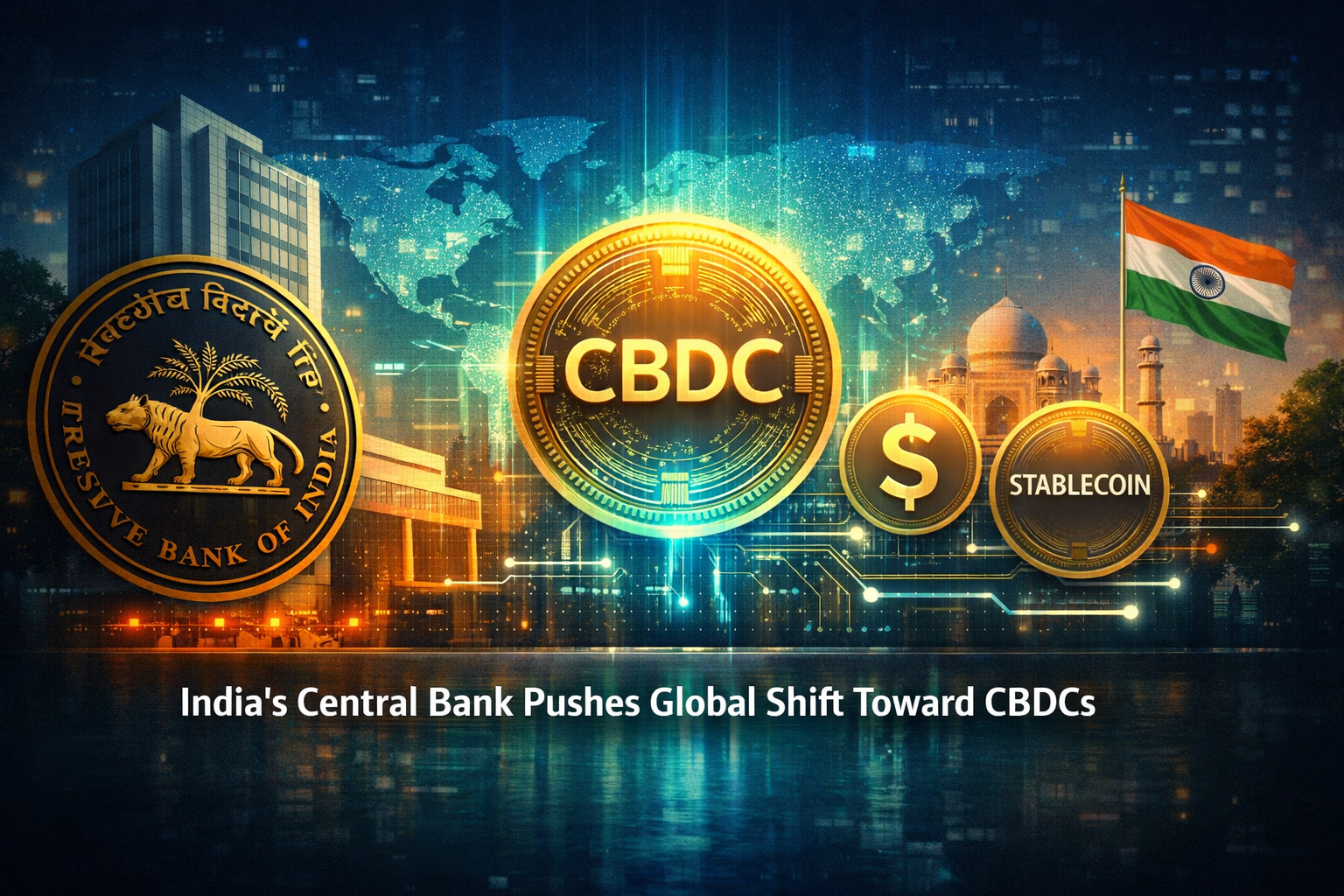
India’s central bank has renewed its call for countries to prioritize central bank digital currencies (CBDCs) over privately issued stablecoins, warning that unchecked stablecoin adoption could pose risks to global financial stability and monetary sovereignty.
In its December Financial Stability Report, the Reserve Bank of India (RBI) argued that CBDCs are better positioned to serve as trusted digital money, while stablecoins could introduce vulnerabilities during periods of market stress. The comments come as governments worldwide debate how to regulate digital assets and as stablecoins continue to see rapid growth in adoption.
RBI’s stance on digital money
The RBI emphasized that CBDCs preserve what it calls the “singleness of money,” meaning all forms of money remain interchangeable at par value and backed by sovereign authority. According to the central bank, CBDCs should remain the “ultimate settlement asset” and the “anchor for trust in money.”
“The RBI strongly advocates that countries should prioritise central bank digital currencies over privately issued stablecoins to maintain trust in money, preserve financial stability and design next generation payments infrastructure that is faster, cheaper and secure,” the bank said in the report.
The RBI warned that stablecoins, especially those issued by private entities, could weaken monetary policy transmission and create new channels for systemic risk if they grow large enough to rival traditional payment systems.
Stablecoins and financial risks
The central bank highlighted that stablecoins may appear resilient during normal market conditions but could amplify instability during periods of stress. A sudden loss of confidence in a stablecoin issuer, the RBI noted, could trigger rapid redemptions and spill over into broader financial markets.
The report stressed that jurisdictions must carefully assess the risks associated with stablecoins and design regulatory responses suited to their domestic financial systems. This cautious tone aligns with the RBI’s long-standing skepticism toward crypto assets, even as global interest in blockchain-based payments accelerates.
India’s evolving crypto policy
India’s government has signaled that it is exploring stablecoin regulations. The Economic Survey 2025–2026 indicated that policymakers are considering frameworks to oversee stablecoin issuance and usage. However, the RBI has consistently advocated a more conservative approach to crypto adoption.
As the country’s monetary authority, the RBI plays a central role in shaping how digital assets are treated in India. Its push for CBDCs reflects a broader effort to ensure that innovation in digital payments does not undermine financial stability or sovereign control over money.
CBDCs versus stablecoins debate
CBDCs remain one of the most debated topics in global finance. Critics argue that CBDCs could erode privacy and disrupt the banking sector by allowing individuals to hold accounts directly with central banks. Others worry about increased state surveillance and reduced competition.
Supporters, however, claim CBDCs can enhance payment efficiency, lower transaction costs, and improve financial inclusion, particularly in developing economies. The RBI has aligned itself firmly with this latter view.
In its report, the central bank stated that CBDCs can deliver all the benefits associated with stablecoins, such as programmability, instant settlement, and efficiency, but without the risks tied to private issuers.
“CBDCs offer these advantages with the credibility and safety of central bank money,” the RBI said, reinforcing its belief that sovereign digital currencies are superior to privately issued alternatives.
Stablecoin market continues growing
Despite regulatory concerns, stablecoins continue to gain traction globally. Financial institutions across the United States, Europe, and Asia are increasingly experimenting with stablecoins to facilitate faster and cheaper cross-border transfers compared with traditional banking rails.
This interest has fueled strong market growth. According to data aggregator DefiLlama, the total market capitalization of stablecoins rose from around $205 billion at the start of 2025 to approximately $307 billion by year-end. The expansion underscores why central banks are paying close attention to the sector’s systemic implications.
Global CBDC adoption remains slow
While stablecoins are scaling rapidly, CBDC adoption has been far slower. Only three CBDCs have been fully launched worldwide—in Nigeria, the Bahamas, and Jamaica, according to the Atlantic Council’s CBDC tracker.
The think tank reports that 49 countries are currently piloting CBDCs, 20 are actively developing them, and 36 are still in the research phase. The slow pace reflects technical challenges, regulatory uncertainty, and political debates surrounding privacy and control.
Nevertheless, central banks like the RBI view CBDCs as a long-term strategic priority rather than a short-term market product.
RBI’s global policy message
By urging countries to prioritize CBDCs over stablecoins, the RBI is positioning itself as a strong advocate for state-backed digital money in the evolving global financial system. Its message reflects growing concern among central banks that private digital currencies could weaken monetary sovereignty if left unchecked.
As digital payments infrastructure continues to evolve, the tension between innovation and stability is likely to intensify. India’s central bank has made it clear that, in its view, CBDCs—not stablecoins—should form the foundation of next-generation money.