 qerranews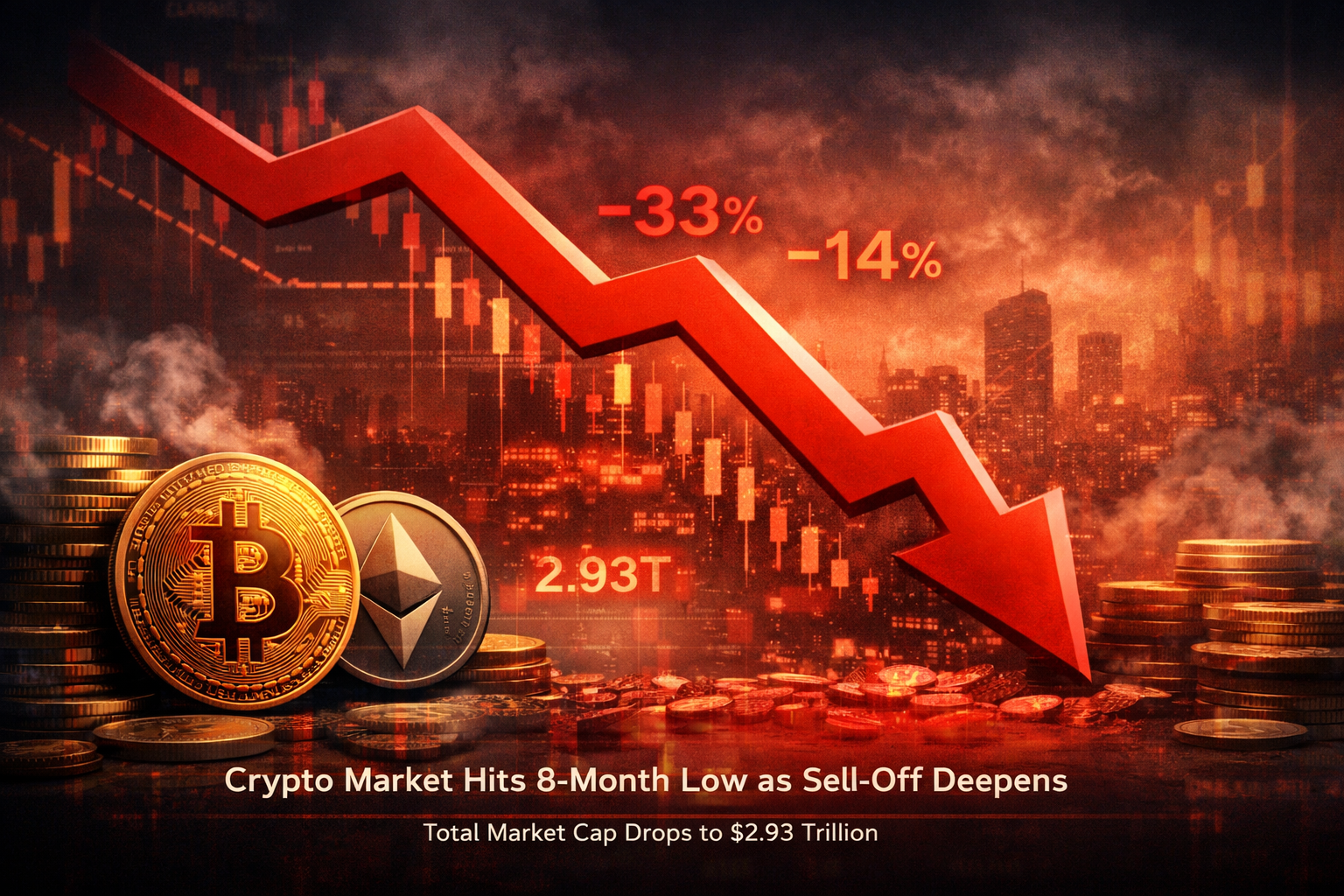
The global cryptocurrency market has slipped into a deeper correction, with total market capitalization falling to its lowest level in eight months. After months of volatile price action and fading optimism, the latest downturn has erased all gains made earlier in the year, reinforcing concerns that the market may be entering a sustained bearish phase.
According to CoinGecko data, the total crypto market cap dropped to $2.93 trillion during late trading on Thursday, marking its lowest point since April. Analysts warn that short-term pain may not be over yet, as macroeconomic pressures and tightening financial conditions continue to weigh heavily on risk assets.
Market Breakdown
The current decline represents a significant reversal from earlier highs. The crypto market has fallen roughly 33% from its all-time high of around $4.4 trillion, recorded in early October. Since the beginning of the year, total market capitalization is down nearly 14%, effectively wiping out all yearly gains.
Earlier in 2025, the market had already tested lower levels, briefly dropping to $2.5 trillion on April 9 before staging a strong recovery that pushed valuations to record highs six months later. However, since March 2024, the overall crypto market cap has largely traded within a broad range. The recent sell-off has now pushed valuations back toward the middle of that range, suggesting renewed uncertainty rather than outright capitulation—at least for now.
Bearish Signals
Many analysts believe the recent drop confirms that the crypto market is facing a broader bearish trend. Risk appetite has declined across global markets, and cryptocurrencies, often viewed as high-risk assets, have been among the hardest hit.
MN Fund co-founder Michaël van de Poppe warned that further downside is likely in the near term. He suggested that the market’s downward momentum could continue until major macroeconomic catalysts, particularly central bank decisions, are fully absorbed by investors.
“Wouldn’t be surprised if Bitcoin continues to cascade and gets itself into a form of capitulation in the next 24 hours,” van de Poppe said, adding that such a move could result in 10% to 20% losses across altcoins before a potential bounce occurs.
Japan Rates
A key macro factor influencing sentiment has been monetary policy in Japan. On Friday, the Bank of Japan raised interest rates to 0.75%, a move that surprised some market participants and added pressure to global risk assets, including cryptocurrencies.
Historically, tighter monetary policy has reduced liquidity in financial markets, often leading to sell-offs in speculative assets. While some analysts viewed the rate hike as negative for crypto, the market reaction was mixed. Bitcoin briefly climbed 2.3% to around $87,180, showing short-term resilience despite broader bearish expectations.
Still, analysts caution that isolated price moves do not necessarily signal a trend reversal, especially when macroeconomic conditions remain uncertain.
Buying Zones
Despite the gloomy outlook, some market observers see the current pullback as a potential opportunity rather than a warning sign. Nick Ruck, director at LVRG Research, said the decline reflects a broader correction driven by macroeconomic pressures and reduced risk appetite.
“While short-term volatility persists, this pullback presents potential accumulation opportunities in fundamentally strong projects,” Ruck noted, emphasizing that the crypto sector continues to mature and attract long-term institutional interest.
For long-term investors, periods of heightened fear have historically offered attractive entry points, particularly for assets with strong use cases, active development, and growing adoption.
Fear Dominates
Sentiment indicators suggest that fear has once again taken control of the market. Blockchain analytics firm Santiment reported that crypto sentiment has dropped sharply, with bearish commentary dominating social media discussions.
According to Santiment, traders reacted negatively after Bitcoin briefly rallied to $90,200 before quickly retracing to $84,800, reinforcing the perception of instability and weak momentum.
Interestingly, Santiment highlighted that extreme bearish sentiment among retail traders has often preceded market reversals in the past. “Prices move opposite to the crowd’s expectations,” the platform noted, suggesting that widespread fear could be a contrarian signal for patient investors.
Fear Index
The widely followed Crypto Fear & Greed Index further confirms the pessimistic mood. The index currently sits at 16, firmly in the “extreme fear” zone, and has remained below 30—classified as “fear”—since early November.
Such prolonged periods of fear often coincide with increased volatility and sharp price swings. While this environment can be challenging for short-term traders, it has historically marked accumulation phases for long-term participants.
What’s Next
With the crypto market cap at an eight-month low and macroeconomic uncertainty still unresolved, analysts expect continued volatility in the coming weeks. Central bank policy, global liquidity conditions, and investor sentiment will likely remain the key drivers of price action.
Whether this correction evolves into a prolonged bear market or sets the stage for another recovery will depend on how quickly confidence returns. For now, the market remains cautious, fearful, and highly sensitive to external shocks.