 qerranews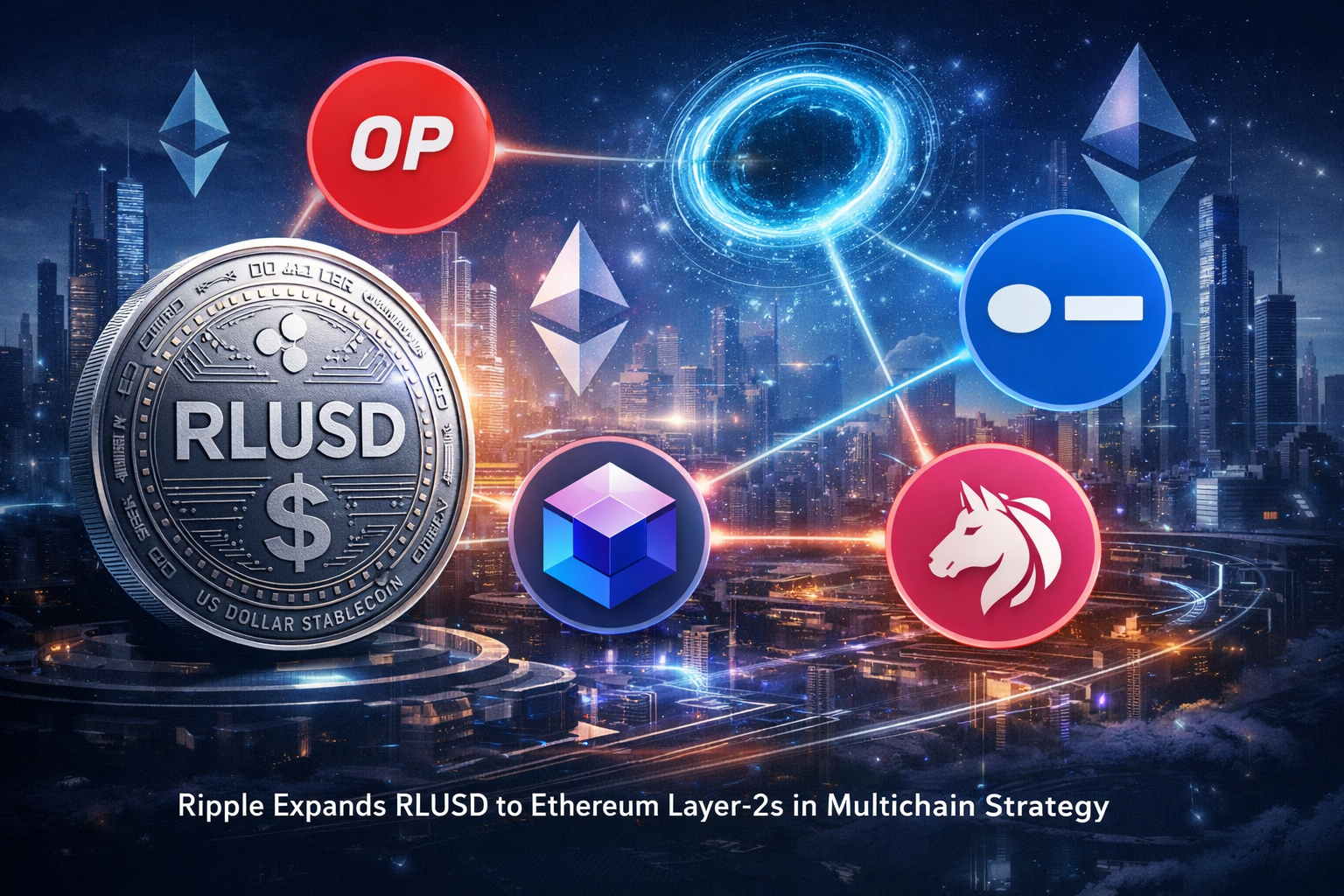
Ripple Labs is deepening its multichain ambitions by piloting its US dollar-backed stablecoin, RLUSD, across multiple Ethereum layer-2 networks. The move marks a significant step in Ripple’s plan to position RLUSD as a regulated, interoperable stablecoin designed for both institutional finance and the growing onchain economy.
Following its initial launch on the XRP Ledger (XRPL) and Ethereum in 2024, RLUSD is now being tested on Optimism, Base, Ink, and Unichain. The pilot is being conducted in partnership with crosschain interoperability protocol Wormhole and will run while Ripple awaits regulatory approval for a broader rollout expected next year.
Multichain Expansion Begins
Ripple confirmed that the RLUSD pilot will allow the stablecoin to operate natively across leading Ethereum scaling networks. Optimism and Base are already among the most widely used layer-2s by total value locked, while Ink represents Kraken’s entry into Ethereum scaling. Unichain, meanwhile, is emerging as a hub for consumer-focused DeFi applications.
By expanding RLUSD to these environments, Ripple is signaling that stablecoin utility can no longer be limited to a single chain. As onchain activity fragments across multiple networks, liquidity and compliance need to move with users rather than remain siloed.
RLUSD is expanding to Layer 2s using @wormhole’s NTT standard for native, secure transfers and will become the first U.S.-based, trust-regulated stablecoin on @Optimism, @Base, @Inkonchain and @Unichain: https://t.co/ju9KyoOIBa
— Ripple (@Ripple) December 15, 2025
This will enhance utility for XRP and RLUSD by…
Ripple said the expansion is “essential for a scalable, efficient, and interoperable future,” reinforcing its long-standing view that blockchain adoption will be inherently multichain.
Why Layer-2s Matter
Ethereum layer-2 networks have become central to crypto’s next growth phase. They offer lower fees, faster settlement, and greater capacity for real-world use cases such as payments, remittances, and DeFi.
For stablecoins, L2s provide a critical environment where everyday transactions can occur without the cost and congestion associated with Ethereum mainnet. By piloting RLUSD on L2s, Ripple is positioning its stablecoin where demand is increasingly concentrated.
Ripple also emphasized that stablecoins must exist “wherever demand and utility are,” particularly as institutional finance begins interacting more directly with onchain markets.
Wormhole Enables Native Transfers
A key component of Ripple’s multichain strategy is its integration with Wormhole’s Native Token Transfers (NTT) standard. Unlike traditional bridge models that lock tokens on one chain and mint wrapped versions on another, NTT allows RLUSD to move as the same canonical asset across blockchains.
With NTT, token issuers eliminate the need for fragmented liquidity or wrapped assets, allowing a single, canonical version of RLUSD to exist natively on each blockchain with Ripple owning the contracts.
— Wormhole (@wormhole) December 15, 2025
Interoperability is a critical need for major asset issuers. By choosing…
This approach avoids fragmented liquidity and reduces the risks associated with synthetic or wrapped tokens. Each deployment of RLUSD remains native, with Ripple maintaining ownership of the contracts across supported chains.
According to Wormhole, this design ensures that a single, unified version of RLUSD exists throughout the multichain ecosystem, improving capital efficiency and simplifying integrations for developers and institutions.
Regulatory Positioning Strengthens
Regulation remains a central pillar of Ripple’s stablecoin strategy. RLUSD is issued under a New York Department of Financial Services (NYDFS) Trust Company Charter, one of the most stringent regulatory frameworks in the US.
Ripple has also applied for a federal trust bank charter from the Office of the Comptroller of the Currency (OCC), which would place RLUSD under additional federal oversight. This dual-track regulatory approach is designed to appeal to institutions seeking compliance clarity amid evolving US stablecoin rules.
Ripple executives argue that as blockchains increasingly power real-world financial infrastructure, demand for highly regulated stablecoins will only intensify.
Institutional Adoption Focus
Jack McDonald, Ripple’s senior vice president of stablecoins, described stablecoins as the “gateway to DeFi and institutional adoption.” He said RLUSD’s expansion onto Ethereum L2s is about more than distribution—it’s about setting a new standard.
By combining regulatory compliance with efficient onchain settlement, Ripple aims to differentiate RLUSD from competitors that prioritize scale over oversight. The company believes this positioning will resonate with banks, fintechs, and payment providers exploring blockchain-based rails.
Market Position Grows
Since launching in December 2024, RLUSD has reached a market capitalization of $1.3 billion, according to CoinGecko. While still small compared to dominant players like Tether’s USDT at $186 billion and Circle’s USDC at $78 billion, RLUSD’s growth reflects rising interest in regulated alternatives.
Sky Protocol’s USDS currently ranks as the third-largest stablecoin with a $9.8 billion market cap, highlighting the competitive landscape Ripple is entering.
RLUSD has also gained traction among retail users through integrations with on-ramp providers like Transak and increasing support across self-custodial wallets, including Xaman.
More Chains Ahead
Ripple confirmed that additional blockchain integrations are planned for next year, pending final regulatory approval. The company has not disclosed which networks are next but suggested that expansion will continue wherever institutional and onchain demand aligns.
As stablecoins become foundational infrastructure for payments, DeFi, and tokenized finance, Ripple’s multichain approach positions RLUSD as a contender built for compliance, scale, and interoperability from the ground up.