 qerranews
Why do so many crypto projects disappear within a year, even when the technology looks promising?
It’s rarely because the blockchain is slow or the idea is bad. In most cases, the real reason is much simpler and far more fundamental: poor tokenomics.
Tokenomics determines how a crypto project survives, grows, and sustains itself over time. It defines how tokens are created, distributed, used, and valued within an ecosystem. When tokenomics is designed well, it supports long-term growth and stability. When it’s designed poorly, even the most innovative projects struggle to survive.
For individuals who want to understand sustainable crypto projects, learning tokenomics is essential. Tokenomics explains why some projects endure market cycles while others fade away after short-lived hype.
This article breaks down what tokenomics is, why it matters, and why it’s the secret sauce for long-term crypto success, and how it keeps crypto project ecosystems healthy.
What is Tokenomics?
Tokenomics is the study of a cryptocurrency’s economic model—how tokens are supplied, distributed, used, and incentivized. It combines “token” and “economics” and describes how a token functions within its ecosystem.
In simple terms, tokenomics answers questions like:
- How many tokens exist?
- How are tokens created or removed?
- Who receives the tokens?
- What are tokens used for?
- How does the system stay balanced over time?
Tokenomics acts as the financial blueprint of a crypto project. Just as traditional businesses rely on revenue models and cost structures, blockchain projects rely on tokenomics to function sustainably.
Why Tokenomics Is Critical for Sustainable Crypto Projects?
Tokenomics is important because it defines how value is created, distributed, and preserved over time within a crypto ecosystem. Well-designed, sustainable tokenomics prevents excessive inflation, aligns incentives across all participants, funds ecosystem growth, and encourages long-term engagement rather than short-term speculation.
Tokenomics aligns users, builders, and stakeholders so everyone benefits from long-term success instead of short-lived hype. Projects that focus on real utility and transparent economic design are far more likely to survive market cycles and maintain trust within their communities.
Tokenomics also plays a critical role in sustainability by controlling token supply, funding ongoing development, and ensuring that contributors are rewarded for meaningful participation. Without strong tokenomics, even technically sound crypto projects can struggle under economic pressure.
In essence, technology enables a project—but tokenomics determines whether it lasts.
- Value Alignment: Tokenomics ensures incentives are aligned across users, builders, and stakeholders for long-term growth.
- Economic Stability: Controlled supply and structured rewards prevent inflation and reduce speculative volatility.
- Sustainable Growth: Strong tokenomics funds development, builds trust, and supports ecosystem expansion over time.
Core Elements of Tokenomics Design
Every sustainable crypto project is built on three main tokenomics components: Token Supply, Distribution & Allocation, and Utility & Economic Purpose. While features and trends may change, these core pillars determine whether a project is designed for long-term success or short-term hype.
Let’s take a closer look at these three essential tokenomics components.
1. Token Supply Structure
Token supply defines how scarce or abundant a token is, directly influencing its long-term value and economic stability. A poorly designed supply model can quickly dilute value, while a well-balanced one supports sustainable growth.
There are three primary token supply models used in crypto projects:
- Fixed supply models: Like Bitcoin’s 21 million cap—creates scarcity, driving value as demand grows.
- Inflationary supply models: Steady minting funds development but risks dilution if unchecked.
- Deflationary mechanisms: Burns reduce supply over time, boosting scarcity.
2. Token Distribution & Allocation Strategy
Token distribution determines who owns the tokens and when they gain access to them. This aspect of tokenomics has a significant impact on decentralization, governance, and long-term trust.
A well-designed allocation model avoids excessive concentration and supports decentralization.
Typical allocation categories include:
- Team and Advisors
Usually allocated with vesting schedules to encourage long-term commitment. - Early Investors and Private Sales
Provide initial funding but often come with lockups. - Public Sale Participants
Enable broader community ownership. - Community and Ecosystem Incentives
Used for rewards, grants, and user growth. - Treasury and Reserves
Fund long-term development and operations.
Fair and transparent distribution is essential for sustainability because it prevents control from being concentrated in the hands of a small group and builds confidence across the ecosystem.
3. Token Utility & Economic Purpose
For a token to hold long-term value, it must have a clear and meaningful role within its ecosystem. Tokens without real utility often struggle to maintain demand once speculation fades.
There are several common categories of token utility:
- Utility tokens: Pay fees, access services (e.g., Filecoin storage).
- Governance tokens: Vote on upgrades (e.g., Uniswap’s UNI).
- Security tokens: Represent assets with regulations.
- Hybrid utility models: Combine perks for stickiness.
Tokenomics Mechanics That Drive Long-Term Value
For a crypto project to remain sustainable over time, its tokenomics must go beyond supply numbers and focus on how tokens move, unlock, and create value within the ecosystem. These mechanics define whether a token supports long-term growth or collapses under economic pressure.
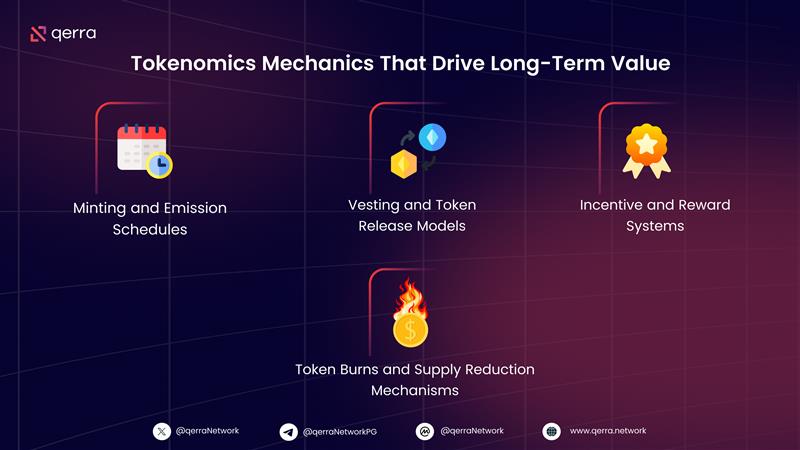
1. Minting and Emission Schedules
Minting refers to the process through which new tokens are created and introduced into circulation. This mechanism plays a critical role in determining whether a token maintains value or suffers from excessive inflation.
2. Vesting and Token Release Models
Vesting determines when tokens become available to their holders, making it one of the most important tools for long-term sustainability. Instead of allowing immediate access to all allocated tokens, vesting introduces time-based or performance-based restrictions on token releases.
Common vesting models include cliff periods, where tokens remain locked for an initial duration, linear vesting that releases tokens gradually over time, and milestone-based vesting tied to project progress.
3. Incentive and Reward Systems
Incentives are the driving force behind user participation in a crypto ecosystem. Well-designed incentive systems reward behaviors that strengthen the network rather than encourage short-term speculation.
Typical incentives include staking rewards that help secure the network, liquidity incentives that support healthy markets, and participation rewards for governance involvement or platform usage. These rewards motivate users to actively contribute to the ecosystem’s growth and stability.
4. Token Burns and Supply Reduction Mechanisms
Token burns are mechanisms that permanently remove tokens from circulation, reducing total supply over time. When implemented responsibly, token burns help and benefits balance inflation and support long-term value.
Burn mechanisms may be linked to transaction fees, protocol usage, or periodic supply adjustments. By tying burns to actual network activity, projects can ensure that supply reduction reflects real demand rather than artificial scarcity.
How Tokenomics Supports Long-Term Sustainability?
Great tokenomics isn’t just theory on a whitepaper — it’s practical economics in action. In sustainable crypto projects, tokenomics plays a direct role in keeping ecosystems stable, scalable, and aligned for the long run.
Well-designed tokenomics supports sustainability by:
- Encouraging long-term participation
- Funding ecosystem development responsibly
- Aligning governance with economic incentives
- Creating real demand through utility
- Supporting resilient and scalable ecosystems
When tokenomics is designed thoughtfully, ecosystems can expand organically, maintain participant trust, and remain resilient across market cycles — without relying on unsustainable rewards or short-term hype.
Conclusion: Tokenomics as the Foundation of Sustainable Crypto Success
Tokenomics plays a measurable and decisive role in determining whether a crypto project can remain functional and relevant over the long term. Projects with well-structured token supply, transparent distribution, clear utility, and controlled incentives are statistically more likely to maintain user participation, network security, and economic stability across market cycles.
From an economic perspective, tokenomics functions as the operating model of a blockchain network. It governs how capital flows, how participation is rewarded, and how long-term development is funded. When these mechanisms are designed with sustainability in mind, the project gains resilience against volatility, declining interest, and external market pressure.
In practice, understanding tokenomics allows individuals to evaluate crypto projects based on fundamentals rather than short-term price movement.