 qerranews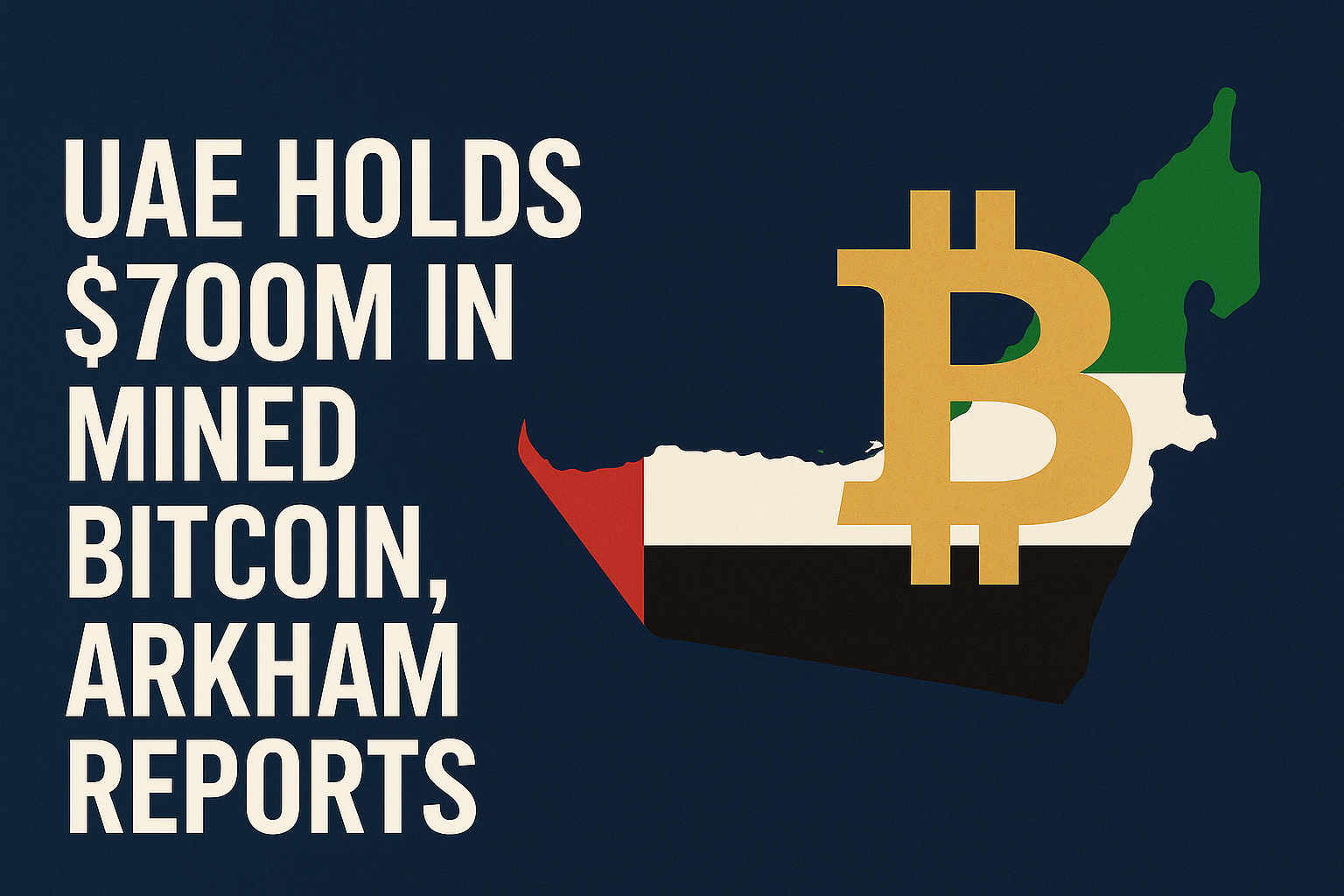
Arkham Reveals UAE Holdings
The United Arab Emirates (UAE) has officially entered the spotlight of nation-state Bitcoin ownership. According to blockchain analytics firm Arkham Intelligence, the UAE government controls approximately 6,300 Bitcoin, worth about $700 million at current market prices.
The data was revealed on Monday through Arkham’s detailed analysis of publicly identified wallets belonging to the UAE government. Contrary to widespread speculation over the past few years, the UAE’s Bitcoin reserves are not in the hundreds of thousands. Previous rumors suggested that the country might hold as much as 420,000 Bitcoin (valued at around $46 billion), allegedly accumulated through seizures similar to how the United States and United Kingdom built their crypto holdings.
Arkham clarified that the UAE’s stash came almost entirely from mining operations, not confiscations. This distinction sets the Emirates apart from other governments, as its Bitcoin position has been built through state-backed industry investment rather than law enforcement seizures.
The holdings were generated through Citadel Mining, a firm majority owned by the International Holding Company (IHC), which itself is controlled by the UAE government.
Arkham stated, “Unlike the US and UK, the UAE’s holdings do not come from police asset seizures but from mining operations with Citadel Mining.”
This revelation highlights how the UAE’s Bitcoin exposure is tied to proactive economic development and its embrace of the digital asset economy, rather than incidental law enforcement actions.
Citadel Mining’s Royal Ties
Citadel Mining is not just another Bitcoin mining company. The firm, established in 2022, has deep connections to Abu Dhabi’s royal family and the nation’s economic ambitions.
Arkham reported that Citadel Mining is 85% owned by 2pointzero, a holding company under the IHC umbrella. The IHC is backed by the UAE Royal Group, which is majority-owned by Sheikh Tahnoon bin Zayed Al Nahyan, the National Security Advisor of the UAE and a key figure in the Abu Dhabi royal family.
Through its partnership with Phoenix Group, a publicly listed UAE mining company, Citadel constructed a state-of-the-art Bitcoin mining facility in Abu Dhabi. Arkham even corroborated this development by aligning satellite imagery of the site’s construction with on-chain mining activity, providing strong evidence that the mined Bitcoin came from UAE-controlled facilities.
So far, Arkham estimates that Citadel has mined 9,300 Bitcoin in total, though some have been transacted, leaving the UAE’s government with around 6,300 Bitcoin still in its wallets.
The link between Citadel Mining and Abu Dhabi’s royal family underscores the strategic role crypto mining plays in the UAE’s broader digital transformation agenda. By investing in mining infrastructure, the Emirates not only earns Bitcoin but also positions itself as a regional hub for blockchain technology and crypto industry development.
UAE’s Rank Among Nations
Despite the discrepancy between rumors and reality, the UAE still ranks as a significant nation-state Bitcoin holder. According to BitBo’s sovereign Bitcoin tracker, the UAE currently ranks sixth globally in government-held Bitcoin.
The breakdown looks like this:
- United States – 198,012 BTC (mostly seized)
- China – 194,000 BTC (from PlusToken scam seizure)
- United Kingdom – 61,245 BTC
- Germany – 50,000+ BTC
- Bhutan – 11,286 BTC
- United Arab Emirates – 6,300 BTC
- El Salvador – 6,246 BTC
The UAE now sits slightly ahead of El Salvador, the first nation to officially adopt Bitcoin as legal tender in 2021. This placement demonstrates that while the UAE is not among the top three, its holdings are still significant when compared to emerging Bitcoin-friendly nations.
BitBo further estimates that 517,000 Bitcoin are currently held by sovereign states, amounting to 2.4% of the total circulating supply. At current valuations, that represents a collective government-controlled treasury of over $56 billion.
For the UAE, the newly reported $700 million stake marks a starting point that could grow as its mining operations expand. Given its favorable energy environment, financial infrastructure, and ambitious government initiatives, the country may be poised to scale up its mining capacity and holdings significantly in the years to come.
Comparisons With Global Reserves
The UAE’s $700 million worth of mined Bitcoin may pale in comparison to some of the massive sovereign reserves, but the strategic difference lies in how the Bitcoin was acquired.
For example, the United States and China—two of the world’s largest holders—amassed their reserves mainly through asset seizures, targeting criminal enterprises and fraudulent schemes like the infamous PlusToken scam. The UK’s large stash also came from law enforcement crackdowns. These nations built their Bitcoin treasuries by accident rather than intention.
In contrast, the UAE has consciously invested in Bitcoin mining, building infrastructure and dedicating resources to generate BTC through energy-backed production. This indicates a forward-looking economic strategy rather than a reactive accumulation.
It also reflects Abu Dhabi’s broader positioning as a crypto-friendly hub, especially with regulatory clarity, institutional partnerships, and new blockchain initiatives like the upcoming dirham stablecoin project backed by local financial giants.
Furthermore, when comparing sovereign reserves to private and corporate holdings, Arkham points out that Bitcoin’s pseudonymous creator, Satoshi Nakamoto, remains the largest single holder, with an estimated 1.096 million BTC. On the corporate front, Michael Saylor’s MicroStrategy controls about 629,376 BTC, or nearly 2.9% of Bitcoin’s total supply.
This context shows that while the UAE’s holdings are modest in relative terms, they still represent a significant strategic entry into sovereign Bitcoin ownership, especially considering that the stash was deliberately mined, not seized.
Final Thoughts
Arkham Intelligence’s findings confirm that the UAE is officially in the global league of Bitcoin-owning nations, though its reserves are far smaller than once rumored. By holding around 6,300 BTC worth $700 million, the country now ranks sixth in sovereign Bitcoin reserves.
Unlike Western nations whose Bitcoin treasuries came from criminal seizures, the UAE’s holdings are the result of deliberate mining operations, tied directly to the royal family and its economic development strategies.
As the Bitcoin mining sector matures, the UAE’s role as a sovereign miner and investor could grow, potentially reshaping global rankings and affirming the Emirates as a regional leader in digital assets and blockchain innovation.