 qerranews
Nano Labs Begins BNB Accumulation
In a bold and unprecedented move, Chinese microchip manufacturer Nano Labs has taken its first concrete step toward a massive BNB accumulation strategy. The company recently disclosed its initial purchase of $50 million worth of Binance Coin (BNB), forming the foundation of its longer-term vision: owning between 5% and 10% of BNB’s total circulating supply.
On Thursday, the firm reaffirmed its goal of allocating up to $1 billion to its crypto treasury, with BNB as the centerpiece. This commitment highlights a growing trend among corporations to integrate crypto assets into their financial reserves—although not without skepticism from parts of the investment community.
Nano Labs now holds a combined $160 million in BNB and Bitcoin (BTC), marking a significant crypto pivot for a firm traditionally known for its production of high-performance computing chips. Founded in 2019 by Kong Jianping and Sun Qifeng—former board members of Singapore-based hardware giant Canaan—Nano Labs went public in 2022 and has since sought to expand beyond traditional semiconductor manufacturing.
Stock Reaction and Market Response
Despite the ambitious announcement, the market’s immediate reaction to Nano Labs’ latest BNB acquisition was tepid. The firm’s stock fell more than 4.7% during Thursday’s regular trading hours, followed by an additional 2% drop after hours, landing at $8.21.
This decline stands in stark contrast to the market enthusiasm seen earlier in the year. Back then, Nano Labs’ share price surged over 106% following the disclosure of plans to issue $500 million in convertible notes to fund its BNB-focused treasury.
The muted investor response this time may reflect caution about the feasibility of the firm’s larger strategy, especially given BNB’s market position and pricing volatility. As of now, BNB trades at approximately $661.64, with a total market cap hovering near $93.4 billion, according to CoinGecko.
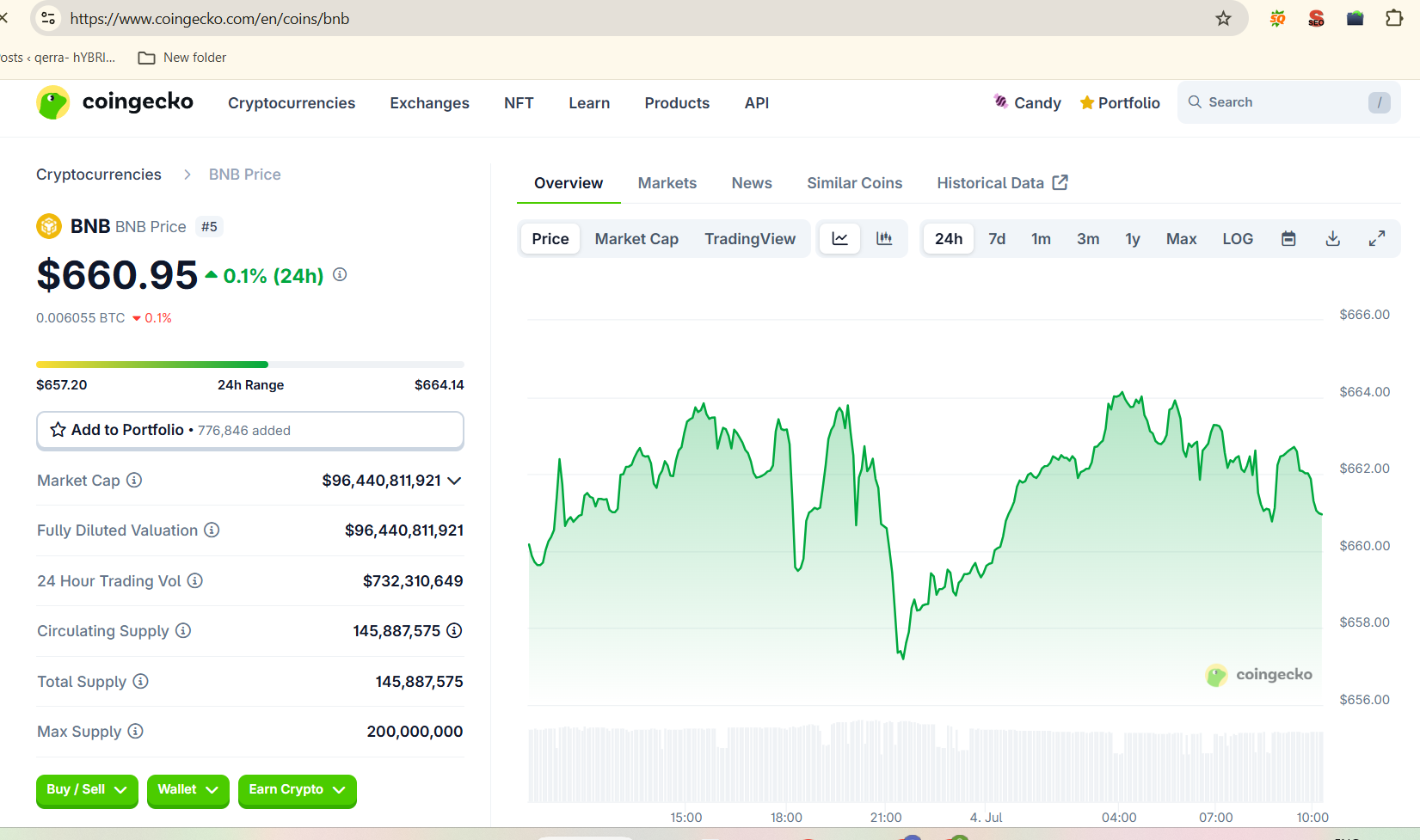
To acquire 10% of the current circulating supply—roughly 145.9 million BNB—Nano Labs would need to spend an estimated $926 million at current prices. Achieving this goal while avoiding significant market disruption and scrutiny from regulators will be no small feat.
Binance Holds the Bulk Supply
Adding to the complexity of Nano Labs’ ambition is the concentration of BNB ownership. According to a June 2024 Forbes report, Binance and its former CEO Changpeng “CZ” Zhao collectively control approximately 71% of the 147 million BNB coins in circulation.
The original BNB supply stood at 200 million coins, but due to Binance’s ongoing token burn mechanisms—where coins are permanently removed from circulation to reduce supply—this number is continually decreasing. The reduction is part of a deflationary economic model designed to increase scarcity and, theoretically, value.
For Nano Labs, this means that the actual amount of BNB available for open market acquisition is considerably less than what total circulation figures might suggest. Aiming to own 10% of what remains outside Binance’s ecosystem could be much more difficult than it appears on paper.
The token’s relatively low liquidity—combined with significant centralized holdings—poses challenges for any large-scale acquisition plan. Every major buy could impact the market price, potentially leading to slippage and raising the firm’s average purchase cost significantly.
Treasury Strategy Faces Criticism
Nano Labs is not alone in pursuing a crypto treasury strategy. Companies like MicroStrategy have famously allocated large portions of their reserves into Bitcoin, inspiring other firms to follow suit. However, not everyone in the investment community is convinced that this model is sustainable in the long run.
Anthony Scaramucci, founder of SkyBridge Capital, voiced his skepticism in a recent Bloomberg interview. While Scaramucci remains bullish on Bitcoin itself, he questioned the logic of investing in companies that are primarily using shareholder funds to hold crypto on their balance sheets.
“The question is, if you’re giving somebody $10 and they’re putting $8 into Bitcoin, are they going to do well? Yes. But you might have been better off just putting $10 into Bitcoin,” Scaramucci said.
He warned that investors should be mindful of the underlying costs and operational complexities associated with publicly traded crypto-holding firms. Though the idea may seem innovative today, Scaramucci doubts whether these corporate crypto treasuries will have enduring appeal.
This commentary comes as many firms look to diversify treasury holdings amid inflation, rising interest rates, and fiat currency volatility. However, the prospect of investing in crypto via corporate intermediaries may lose its allure if direct crypto access becomes easier and more trusted.
Conclusion: Bold Vision, Uncertain Path
Nano Labs’ push to accumulate up to 10% of BNB’s supply is ambitious, attention-grabbing, and not without merit. It signals confidence in Binance’s ecosystem and the broader longevity of BNB as a strategic asset. However, the road ahead is filled with practical, economic, and reputational hurdles.
From the limited availability of BNB and centralization concerns to potential regulatory scrutiny and shareholder pushback, Nano Labs must navigate a complex landscape to fulfill its vision. Additionally, broader market sentiment and macroeconomic factors will play a role in whether crypto treasury strategies like this can survive beyond the current hype cycle.
Whether Nano Labs becomes the MicroStrategy of BNB or a cautionary tale remains to be seen—but its entry into the crypto treasury game has certainly raised the stakes.
Key Takeaways:
- Nano Labs has initiated a plan to acquire up to 10% of BNB’s supply, with $50 million already invested.
- The company currently holds around $160 million in crypto assets, including BNB and Bitcoin.
- Despite the announcement, its stock price dropped, indicating mixed investor sentiment.
- Experts like Anthony Scaramucci question the long-term viability of corporate crypto treasuries.
- Binance and CZ control a significant share of BNB, limiting available supply for outside buyers.